Stephen Kovacevich (1940–2026): Remembering a Pianist of Extraordinary Colour and Nuance
A personal remembrance of Stephen Kovacevich, tracing two decades of performances, his distinctive approach to the piano, lifelong struggle with stage fright, and the musical ideas and interpretations that made him such a remarkable artist.

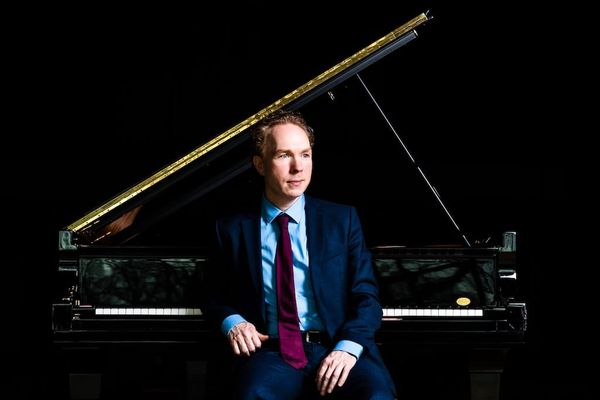
One of the greatest pianists of our time, Stephen Kovacevich, passed away on 27 October 2026.
He had been on my mind as I had recently watched a documentary in which he was asked how he achieved his unique sound quality at his instrument.
His answer intrigued me. “When I’m in very good shape, my fingers are flat. It sounds phony, but I don’t think it is,” was his response. “You have more flesh on the keyboard. And although it’s not a violin, I think the actual contact means you have more control connected to your inner ear.” His interviewer, the BBC Music Magazine award-winning pianist Francesco Piemontesi proceeded to try this out, playing a passage from the second movement of Rachmaninov’s Piano Concerto No. 4 in G minor, Op. 40. They both agreed the resultant sound was now “richer.” But then they discovered the advice did not work in other musical examples. Clearly the answer could never be that simple.
It took me a while to learn that Stephen Bishop and Stephen Kovacevich were the same pianist. Bishop was the surname he acquired from his mother’s second marriage, and which he used in his early career. As that led to confusion with the American singer, songwriter and guitarist of the identical name, he subsequently adopted the hyphenated surname Bishop-Kovacevich before finally settling on Kovacevich, his Croatian-origin father’s surname.
My first experience of hearing Kovacevich perform live was at the BBC Proms festival on 19 August 1998 (literally days after I arrived to live and work in London), when he played Brahms’s First Piano Concerto in D minor, with Osmo Vänskä conducting the BBC Scottish Symphony Orchestra (BBCSSO). I heard him twice more at the Proms: Beethoven’s First Piano Concerto in C major, Ilan Volkov at the helm of the BBCSSO (8 August 2003); and Mozart’s Piano Concerto No. 25 in C major, K. 503, Volkov/BBCSSO (9 August 2006).
On returning to India, I had to make a trip to Mumbai to hear Kovacevich play Beethoven’s Fourth Piano Concerto in G major, Op. 58, with Evgeny Bushkov conducting the Symphony Orchestra of India (24 September 2011).
Years later, in January 2018, I hear Kovacevich in Mumbai in a solo piano concert whose weighty programme included all the Big Bs (Bach, Beethoven and Brahms) and Schubert: Bach: Prelude and Fugue No. 4 in C-sharp minor, BWV 849; Schubert: Piano Sonata in A major, D. 959, the middle of his last three sonatas; Brahms: Ballade Op. 10 No. 4 in B major; two Brahms Intermezzi (Op. 119 No. 1 in B minor, and Op. 76 No. 3 in A-flat major) and a “late” Beethoven piano sonata (No. 31 Op. 110 in A-flat major).
I learned of the death of Kovacevich from a Facebook post by British music writer, novelist, playwright and opera librettist Jessica Duchen, who had recently interviewed him for her book ‘Myra Hess: National Treasure’ (2025), the first biography of that great pianist to appear in nearly 50 years.
Born in Los Angeles, USA, Kovacevich came to London in 1958 on a scholarship to study with Hess, who encouraged him to make Mozart, Beethoven, Schubert and Brahms the core of his repertoire. Judging from his concerts I was privileged to go to, spanning two decades and two continents, he followed his teacher’s advice.
Speaking to Duchen in 2001 about his experience studying with Hess, he said, “She knew that technique concerns sound as well as velocity. You need the technique to be able to create all the variations in sound that you want, and she worked very hard with me on the ability to play quietly but with the full power of the music.”
Kovacevich spoke freely of his lifelong struggle with nerves and anxiety. As recently as August 2026, in an interview with Camille de Rijk, Belgian journalist, editor and founder of the classical music and opera platform Forumopera.com, he admitted to “horrible battles with stage fright all my life.” He continued, “It is too personal to go into, but the problem is much, much less now. I do not want to sound like a politician and evade your question, but I do not actually know what finally helped. Analysis did not help. Talking with a sports psychologist sometimes did. There were other solutions that I would rather not discuss, but solutions do exist. It takes time.”
If there were nerves at play during his concerts that I went to, they were not apparent to me. What came through was a refreshing honesty and big-heartedness in his playing. More than one music critic called him a “free spirit.” One even referred to “free fingers”, calling to mind what he had said in the documentary about his fingers when he was “in very good shape.”
Other observations of Kovacevich’s pianism were his “wonderful palette of colour and nuance”, his “poetic concentration” something I will treasure particularly in the more intimate setting of his 2018 concert in Mumbai.
Kovacevich told Duchen that his “obsession” with Beethoven began in his 20s. “It seemed to me that the subtext of late Beethoven was metaphysical speculation - concerning energy in excess, rage in excess, with a dimension that was almost religious. The fury of the Hammerklavier Sonata's fugue and the radiance of Op 109 are not available only in 'earthly' terms. Angels and devils have to be around to produce this kind of luminosity and darkness."
Speaking of the “early” Beethoven sonatas, he said, “They're full of fun and virtuosity - I love all that. Beethoven is wonderfully immodest about his profundity. He has all the normal, pretentious faults of a young person reeking of talent, and sometimes he's too self-absorbed. And sometimes people don't realise how subversive he is, not only in the context of society but also to his own aesthetic. I wish people would get off their knees and see it for what it is. He's almost like Christ going into the temple and throwing out all the phoney priests. Sometimes he also throws out the phoney priest in himself."
I am increasingly fascinated by how musicians find religious frames of reference to speak about music even when those works are not conventionally considered ‘sacred’.
Camille de Rijk asked Kovacevich: “Schubert is said to have asked friends to play one of Beethoven’s late string quartets as he lay dying. What would you choose?”
His perhaps light-headed choice in August 2026 had been Ravel’s whirling ‘La Valse’. “For two pianos?” pressed Rjk further, to which he retorted, “No — Yuja Wang playing. I do not know. It is a way to go out.”
The solo piano transcription of this orchestral work is fiendishly difficult so Wang would have been the perfect choice.
Ravel himself dismissed all attempts to read “parody, caricature” or “tragic allusion” in ‘La Valse’, saying, “…One should only see in it what the music expresses: an ascending progression of sonority, to which the stage comes along to add light and movement."
Kovacevich “goes out” leaving the world bereft, but he lives on in his recordings. I urge you to listen to him play the complete set of Beethoven piano sonatas and much more. Rest in peace, Maestro.
This article first appeared in The Navhind Times, Goa, India.