The Founders of Film Music: Max Steiner and Erich Korngold
Max Steiner and Erich Wolfgang Korngold transformed cinema through their sweeping orchestral scores, bringing the traditions of European Romantic music to Hollywood and establishing the musical language that continues to shape film composition today.

Before film music became an industry of its own, with celebrated composers, recording studios and concert performances of movie soundtracks, the relationship between cinema and orchestral music was still being defined. The arrival of sound transformed filmmaking in the late 1920s, creating an entirely new artistic possibility: music could now accompany the action on screen, intensify its emotional impact and become an integral part of the storytelling. Two composers, Max Steiner and Erich Wolfgang Korngold, played an extraordinary role in shaping this new language. Drawing upon the traditions of nineteenth-century Romantic orchestral music, they established many of the techniques that continue to define film scoring today.
Their journeys to Hollywood began in Vienna, a city whose musical culture had been shaped by composers such as Mozart, Beethoven, Brahms, Mahler and Richard Strauss. Both men received rigorous musical training and possessed an intimate understanding of the symphony orchestra. When they arrived in the United States, they brought with them a European musical sensibility that would transform the sound of American cinema.
Max Steiner: The Architect of the Hollywood Sound
Born in Vienna in 1888, Maximilian Raoul Steiner grew up in a family closely connected to the city's theatrical world. His grandfather, Maximilian Steiner, was a prominent theatre director, while his father managed the historic Theater an der Wien. Surrounded by musicians and performers from an early age, Steiner demonstrated considerable musical ability and studied at the Imperial Academy of Music in Vienna, where he received instruction from Johannes Brahms and Robert Fuchs.
He subsequently worked as a conductor and musical director in London before moving to New York in 1914. There, he established himself in the world of musical theatre, working on Broadway productions and developing the practical skills of arranging, orchestrating and conducting. His experience in theatre would prove invaluable when Hollywood began searching for composers who could produce music on an entirely different scale.
Steiner moved to Los Angeles in 1929, initially working as an orchestrator and musical director. His major breakthrough came when RKO Pictures commissioned him to compose the score for King Kong (1933), directed by Merian C. Cooper and Ernest B. Schoedsack.
At the time, many films relied on collections of existing musical pieces, short passages of incidental music or relatively sparse accompaniment. Steiner approached King Kong differently, writing an extensive original orchestral score that followed the action closely and gave individual characters, creatures and situations their own musical identities.
The result was revolutionary. As Kong emerges from the jungle, battles prehistoric creatures and develops an attachment to Ann Darrow, the orchestra becomes an essential part of the narrative. Sweeping strings, powerful brass, dramatic percussion and recurring musical themes give the film an emotional and dramatic dimension that its images alone could not achieve.
Steiner demonstrated that film music could do much more than accompany a scene. It could establish atmosphere, suggest danger, communicate emotions and guide the audience's response to events unfolding on screen.
His subsequent career included some of Hollywood's most celebrated productions. Among his best-known scores were The Informer (1935), Gone with the Wind (1939), Casablanca (1942), Now, Voyager (1942) and Since You Went Away(1944).
His score for Gone with the Wind, in particular, became one of the defining examples of the classical Hollywood orchestral tradition. Its principal theme, associated with the character of Scarlett O'Hara and the American South, is immediately recognisable. Throughout the film, Steiner uses recurring musical ideas to establish character, reinforce dramatic developments and create continuity across an expansive narrative.
He also helped popularise the technique of leitmotif, in which a particular melody or musical idea becomes associated with a character, place, relationship or dramatic concept. Although the technique had been developed extensively by Richard Wagner in nineteenth-century opera, Steiner adapted it to the demands of cinema, allowing musical themes to evolve alongside the story.
Erich Wolfgang Korngold: From Opera Prodigy to Hollywood
If Steiner helped establish the practical foundations of Hollywood film scoring, Erich Wolfgang Korngold brought to it the sophistication and orchestral richness of the late Romantic tradition.
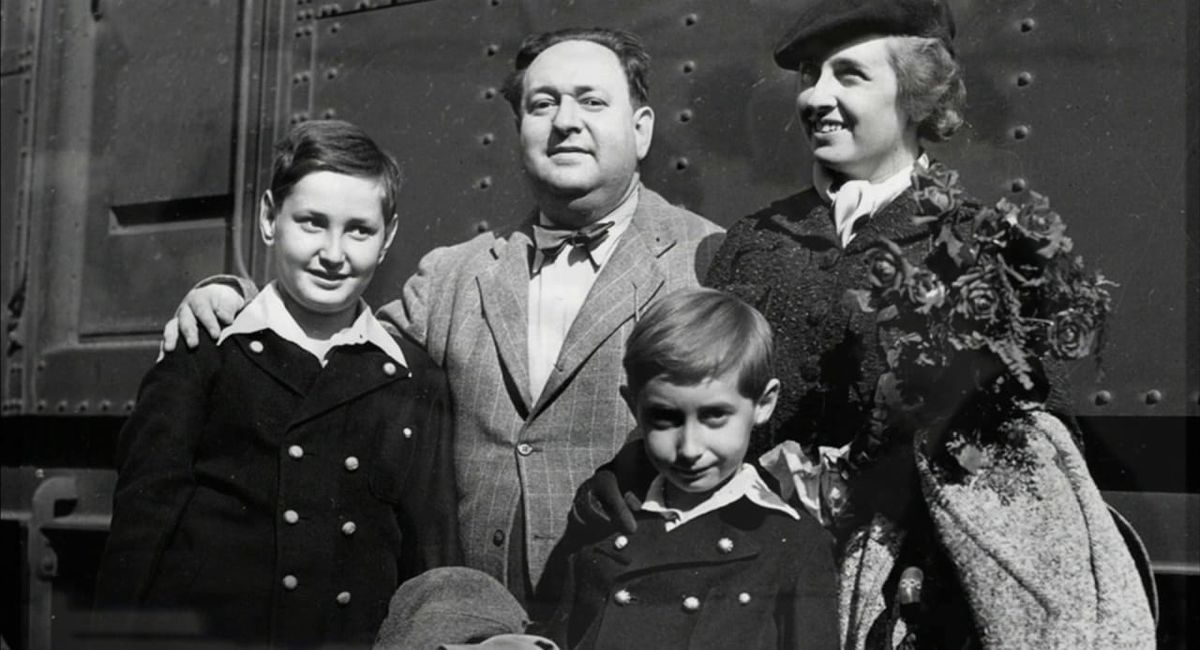
Born in Brünn, then part of the Austro-Hungarian Empire, in 1897, Korngold was recognised as a musical prodigy from childhood. His father, Julius Korngold, was a prominent music critic in Vienna, and the young composer attracted the attention of Gustav Mahler, who reportedly described him as a genius after hearing his early compositions.
Korngold went on to study with Alexander von Zemlinsky and established himself as one of the most remarkable composers of his generation. His early works included orchestral compositions, chamber music and operas, with Die tote Stadt (The Dead City), premiered in 1920, becoming an international success.
His reputation in Europe was already considerable when he first became involved with Hollywood. In 1934, he was invited to adapt Mendelssohn's incidental music for a film version of A Midsummer Night's Dream, directed by Max Reinhardt. The production introduced him to the possibilities of cinema, although he initially regarded film composition as a temporary diversion from his operatic career.
His subsequent involvement with Warner Bros. would change the course of his professional life.
In 1935, Korngold composed the score for Captain Blood, an adventure film starring Errol Flynn and Olivia de Havilland. The film's success, together with its energetic orchestral score, demonstrated how music could elevate the excitement and scale of an action sequence. Korngold's writing was particularly effective in the film's sword-fighting scenes, where rapid orchestral passages, bold brass and sweeping strings gave the action a sense of grandeur.
He followed this with The Adventures of Robin Hood (1938), another Errol Flynn production that remains one of the most celebrated examples of classical Hollywood film music. The score is filled with heroic melodies, elaborate orchestration and dramatic musical gestures, reflecting Korngold's background in opera and symphonic composition.
His work earned him the Academy Award for Best Original Score, making it one of the defining achievements of his Hollywood career. He had previously received the same award for Anthony Adverse (1936).
Korngold approached film composition with the instincts of a symphonic composer. Rather than treating music as a collection of short passages inserted between scenes, he often conceived the score as an extended musical structure. Themes could be introduced, transformed and developed, while the orchestra provided a continuous emotional thread.
His scores also demonstrated the expressive possibilities of orchestral colour. Rich string writing, elaborate woodwind passages, powerful brass and intricate harmonic textures gave his music a distinctly European Romantic character.
Two Composers, One Musical Revolution
Steiner and Korngold shared a musical heritage, but their approaches to film composition were not identical.
Steiner was particularly skilled at synchronising music with the movement and dramatic developments on screen. His scores frequently employed mickey-mousing, a technique in which musical gestures closely follow physical actions, such as footsteps, movements or sudden changes in the scene. He was also exceptionally productive, composing scores for hundreds of films during his career.
Korngold, meanwhile, often favoured a more expansive and symphonic approach. His music could give an entire sequence a sense of continuity, allowing the orchestra to function almost as an additional narrative voice. His background in opera also influenced his use of recurring themes and dramatic musical structures.
Both composers drew heavily upon the traditions of Romantic orchestral music, particularly the works of Wagner, Strauss and the great nineteenth-century symphonists. Their scores demonstrated that the orchestra could communicate emotions and dramatic ideas with a sophistication comparable to that found in opera and concert music.
Their influence extended well beyond their own filmographies. The generations of composers who followed them inherited a musical vocabulary that included recurring themes, elaborate orchestration, dramatic harmonic progressions and the use of symphonic structures to support cinematic storytelling.
The Legacy of Steiner and Korngold
The influence of these two composers can be heard throughout the history of film music. John Williams, whose scores for Star Wars, Superman, Indiana Jones and Harry Potter have become central to modern cinema, has frequently acknowledged the importance of the classical Hollywood tradition. His use of leitmotifs, sweeping orchestral melodies and richly developed themes owes much to the foundations established by Steiner and Korngold.
The connection is particularly evident in Star Wars (1977), whose heroic orchestral language recalls the adventure scores of Korngold. Indeed, the film's musical world helped revive an approach to film composition that had become less prominent during the preceding decades, when jazz, popular music and more experimental orchestral techniques increasingly found their way into cinema.
Korngold himself eventually returned to concert composition, partly in response to the changing political circumstances in Europe and the outbreak of the Second World War. Having settled in the United States, he continued composing for Warner Bros. until 1946, after which he concentrated on concert works. His later compositions included a Violin Concerto, premiered in 1947, which incorporated material from several of his film scores.
Steiner remained active in Hollywood for much of his life, continuing to compose for films into the 1960s. Both men left behind an extraordinary body of work that demonstrated the artistic potential of cinema as a medium for orchestral music.
Today, film scores are performed regularly in concert halls, recorded by major symphony orchestras and studied in music conservatoires. The relationship between classical music and cinema has also become increasingly prominent, with audiences discovering the orchestral traditions behind some of their favourite films.
The achievements of Max Steiner and Erich Wolfgang Korngold remind us that this relationship was not inevitable. It was created through the imagination, musical knowledge and technical ingenuity of composers who recognised that the orchestra could become one of cinema's most powerful storytelling instruments. In establishing the foundations of the symphonic film score, they helped create a musical language that continues to resonate across generations.