Remembering Asha Bhosle and the Kronos Quartet Collaboration
Asha Bhosle’s collaboration with the Kronos Quartet brought Bollywood and contemporary classical worlds together. This personal reflection revisits that landmark project and a memorable Barbican concert that captured her voice, charisma and lasting cultural impact.


The Kronos Quartet is a prestigious string quartet, over half a century old, having been founded in 1973 in Seattle Washington. More than 1200 works have been written for it.
As you can imagine, over such a long innings, it has had a rotating membership of musicians, but the one constant member has been its founder, first violinist David Harrington.
The quartet covers a very broad range of musical genres, including contemporary classical music. During my England years, when my rotating jobs on the NHS (National Health Service) made it inconvenient to purchase too many CDs as I’d have to lug them along from one matchbox space to another, I’d borrow Kronos Quartet albums from the excellent Barbican music library. This was before the internet became an alternative resource. They helped me explore a lot of music I had never heard before.
English music critic, journalist, broadcaster and translator Ken Hunt who is also an authority on Indian classical music and a fan of Hindi film music (today called Bolywood) has had a connection with the Kronos Quartet since the early 1980s, writing CD sleeve notes for some of their albums.
It was while Hunt was compiling an album for the recently-deceased Bollywood playback queen Asha Bhosle (1933 – 2026) that he got the idea of her collaboration with the Kronos Quartet, with a special focus on the music of her later husband R. D. (Rahul Dev) Burman (1939 – 1994).
Kronos Quartet were extremely receptive. In Harrington’s view, Burman’s music was of “global significance.” Iin an interview to The Independent in 2005, he lavished high praise: "The more I listened to music from Indian films, the more I recognised that Burman's music was always my favourite. I began to realise that, as an orchestrator, he's as good as Stravinsky or Debussy or Duke Ellington, and as a melody writer, he's on the same level as Schubert or Gershwin or the Beatles."
About Asha Bhosle, he said, “She commands one of the biggest vocabularies of all the musicians I've encountered. What she can do with her voice is beyond belief. It's like this amazing natural resource: she has the capability of making her voice like one of the instruments we play, and also of being the quintessential vocalist. And she can move between these modes quite naturally."
Small wonder then, that Asha Bhosle sold “more records than Elvis and the Beatles combined.”
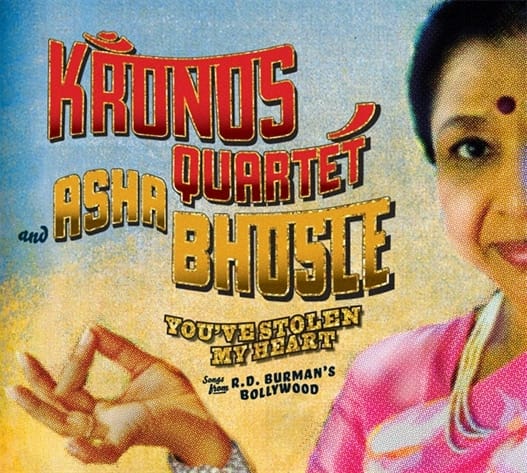
If her collaboration with the Kronos Quarter seems unusual, it is worthwhile remembering she also partnered in the past with Boy George and with Depeche Mode, calling the latter collaboration ‘the West India Company’.
Harrington chose 12 songs for their album, eight of which Bhosle would sing, with the other four being played by the quartet.
The tracks Bhosle sang were ‘Dum maro Dum’ (from ‘Hare Krishna Hare Ram’ 1971); ‘Rishte Bante Hain’(from ‘Dil Padosi Hai 1987); ‘a Bengali song Ekta Deshlai Kathi Jwalao’; ‘Koi Aaya Aana Bhi De’ (from Kaala Sona’ 1975); ‘Mera Kuchh Saamaan’ (from ‘Ijazat’ 1987); ‘Piya Tu Ab To Aaja’ (from ‘Caravan’ 1971); the song that gave the album its English title ‘You’ve Stolen My Heart’; yes, ‘Chura Liya Hai Tum Ne Jo Dil ko’ (from ‘Yaadon ki Baaraat’ 1973, a film that brings back a lot of childhood memories and whose “three brothers lost and found” formula was probably the inspiration for the even more iconic ‘Ama Akbar Anthony’ 1977); and ‘Saiyan Re Saiyan’ (from ‘The Train’ 1970).
The remaining tracks were ‘Mehbooba Mehbooba’ (from another classic, ‘Sholay’ 1975); ‘Nodir Pare Utthchhe Dhnoa’ (‘Smoke rises across the river’); ‘Saajan Kahaan Jaaoongi Main’ (from ‘Jaise ko Taisa’ 1973); and ‘Dhanno ki Aankhon’ (from ‘Kitaab’ 1977).
In addition to Bhosle and the Kronos Quartet, there were eight other musicians also involved, notably table maestro Zakir Hussain and the Chinese pipa (a four-stringed, pear-shaped Chinese plucked lute with a 2000-year history) virtuoso and composer Wu Man. "We needed a plucked instrument with a much greater range of colour than you can get from the guitar," explained Harrington.
Harrington used Burman’s own recordings as his templates, and gathered an arsenal of sound effects. All instrumentalists were called upon to play more than their primary instrument for the desired sound effects. “If it could make a sound, it became an instrument”, said Harrington. An interesting sound effect used was “bow percussion”, eight violin bows clicking together. Another effect was “hammered violin”; I can only hope it was not as traumatic as its name suggests.
Throughout my England decade, no matter how far my NHS job took me from London, I continued to be a member of its Barbican Centre. It had many advantages: use of their library to borrow CDs, DVDs, music books and scores; discounts and priority bookings for selected events, and discounts at their restaurants.
I must have heard of the Barbican concert to launch Asha Bhosle and the Kronos Quartet’s album ‘You’ve Stolen My Heart’ via its email newsletter. The concert was on a Friday night, 7 October 2005. I booked tickets for my wife Chryselle and myself over the phone just in time. The concert sold out very quickly.
Over twenty years later, the memory of that concert is blurry. What I do remember is the atmosphere in the hall. People had pitched up from far and wide; if I remember right the couple seated next to us had come from Birmingham specially for the concert.
I also remember how Bhosle-ji worked the crowd, flirted with it, teased it. By then a septuagenarian, she still exuded youth and vitality.
In her interview to The Independent, Bhosle looked back with amusement at her early years as a playback singer: "First they composed music, then they played it for us, and told us how they wanted the songs to be done. Then we read the words, and worked out what feelings they wanted. They might have said, ‘the actress is 18 years old, so you must sing as she would”. ‘Or they might have said ‘middle class’, or ‘an old lady singing, sing like that”. ‘Or they might have said, ‘it's a cabaret’, so I would have to sing as though I am dancing and crying inside. By the time I was in front of the mike, believing I'm the actress, then I could sing."
In that sense, Bhosle was an actress too, and we saw that play out on stage. I particularly remember how she brought the house down with ‘Chura Liya’, the whole audience singing all the lyrics along with her, many with tears in their eyes, perhaps in response to the beauty of her voice, or to the memories the song triggered, or both.
It was the first and only time I ever heard Asha-ji live, and I’m so glad I took the impulsive decision to go to that historic concert.
It will be the thirtieth anniversary next year of ‘Brimful of Asha’, the 1997 tribute song to her by English alternative rock band ‘Cornershop.’ The BBC then noted its significance as “it marks a point where two types of popular culture were finally brought together in the UK charts: namely, Indie rock and Bollywood film.”
You’ve stolen our hearts, Asha-ji. Rest in peace.
This article first appeared in The Navhind Times, Goa, India.