Mary Hopper and Sharmila Livingston on Music, Mentorship, and Building Choral Communities
A four-decade friendship between conductor Mary Hopper and Delhi-based musician Sharmila Livingston culminates in a rare artistic collaboration in India, rooted in mentorship, collective singing, and the enduring human power of choral music.

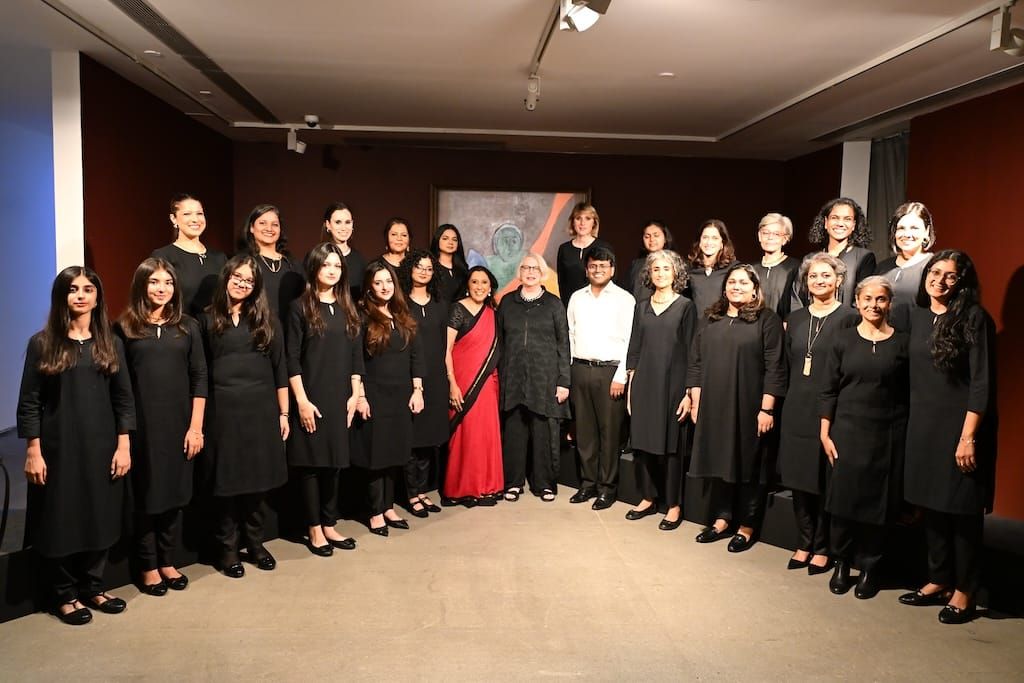
For Sharmila Livingston, arriving at Wheaton College in Illinois in the early 1980s was both exhilarating and intimidating. An Indian student pursuing music in the United States at the time was still something of a rarity, and standing before a conductor for the first time proved transformative. That conductor was Mary Hopper, then an emerging choral educator building what would become one of the most respected careers in American choral music.
Over the next four decades, Hopper would go on to serve as National President of the American Choral Directors Association (ACDA), lead acclaimed ensembles at Wheaton College, and become one of the most respected voices in choral education in the United States. Livingston, meanwhile, returned to Delhi and quietly built her own musical ecosystem, training singers, directing large-scale productions, and more recently founding Mirai, a women’s ensemble committed to expanding the possibilities of choral music in India.
What began as a student-teacher relationship gradually evolved into a friendship shaped by artistic exchange, mentorship, and a shared belief in the communal power of singing. This year, that journey came full circle as Hopper finally travelled to India to work with Livingston and her singers, a collaboration decades in the making.
In this conversation, Mary Hopper and Sharmila Livingston reflect on music education, conducting, mentorship, vulnerability in singing, and the challenges and possibilities of building choral culture across vastly different musical landscapes.
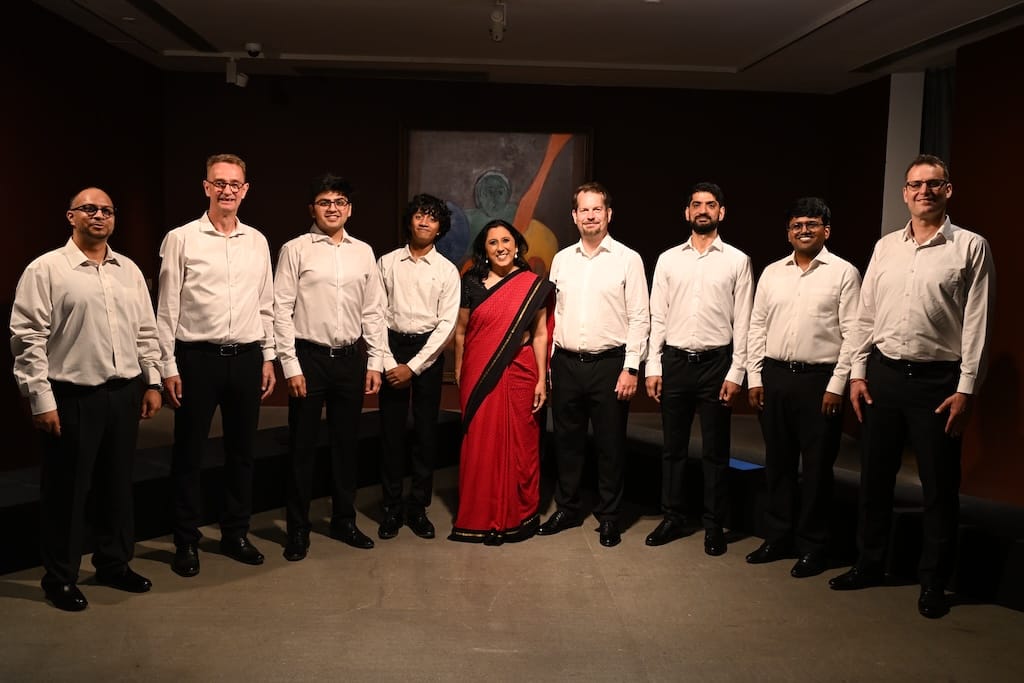
Nikhil Sardana: Sharmila, you first met Mary when you arrived at Wheaton College as a student in the United States. Looking back after four decades of friendship and mentorship, what impact did she have on you both musically and personally?
Sharmila Livingston: When I first arrived at Wheaton in the early 1980s, I was completely intimidated by the calibre of both the students and the professors. In those days, it was not very common for Indian students to pursue undergraduate studies in the United States, especially with a focus on music. As a music student, I was required to join an ensemble on campus, and I chose the all-women’s ensemble that Dr. Hopper was conducting.
It was the first time I had ever stood in front of a conductor. Before that, in India, I had only watched conductors from the audience. I watched Dr. Hopper work with 50–60 women’s voices to create a blended, balanced, beautiful sound, and I absorbed her teaching like a very dry sponge soaking everything in.
At the time, she was also pursuing her doctorate in choral studies, which was deeply inspiring to me. Even as a young musician at the beginning of her career, she already had a reputation for being demanding and disciplined. It was remarkable to watch her grow into leadership roles and gain recognition in the choral world as a woman conductor. Looking back now, I am not surprised that when I founded Mirai, it became an all-women’s ensemble — undoubtedly the result of seeds planted very early in my musical education.
NS: Mary, when you first worked with Sharmila as a young singer, did you imagine your musical journeys would reconnect in this way so many years later in India?
Mary Hopper: I really had no idea that this kind of collaboration would eventually take place. Sharmila was a young — and I think she would agree, rather inexperienced — musician at the time. But she was eager, curious, and clearly serious about her conservatory training.
It wasn’t until many years later, perhaps around ten years ago, that we reconnected as she was developing her voice studio, working in musical production, and becoming more deeply involved in choral music. At that point, I was able to encourage and guide her as she made decisions about further study and professional growth. Her decision to pursue a master’s degree in choral conducting felt like a very natural and logical next step.
NS: Sharmila, you have spoken about wanting Mary to come to India for many years. What does it mean to finally make this collaboration possible?
SL: I have had an open invitation out to Dr. Hopper for many years. It has been difficult to find qualified leaders in the choral space in Delhi with whom I could engage, exchange ideas, and discuss the technical and artistic challenges involved in conducting and training Mirai.
I felt it would be of immense value to have someone of Dr. Hopper’s calibre come and work with my singers. In a metaphorical sense, it felt like inviting her to work with her “grandchildren.” It was a deeply meaningful experience for me personally and artistically.
NS: Mary, what were your impressions of working with singers and audiences during your recent visit and concerts in India?
MH: First of all, the audiences we performed for were tremendously enthusiastic, appreciative, and, in my perception, genuinely moved by Mirai’s performances. They were especially joyful during the premiere performance of Major.
Working with the singers was also deeply gratifying because they were so willing to explore and try new things. Sharmila had prepared them musically with such care that we were able to focus our rehearsals on tone, expression, and communication rather than simply learning notes.
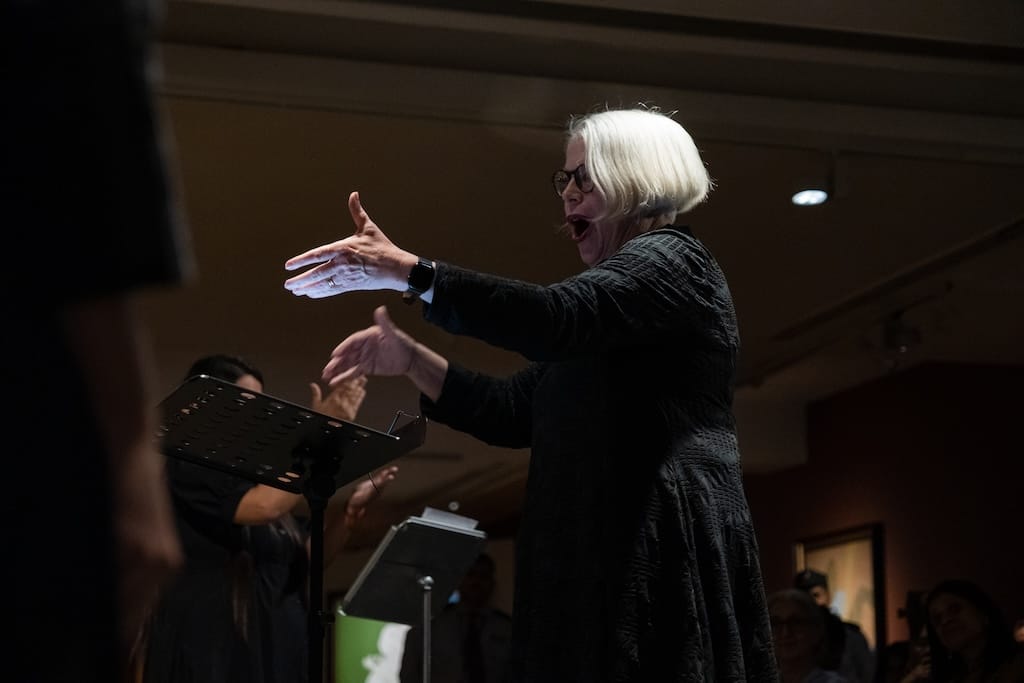
One of the interesting challenges was the wide age range within the ensemble — from teenage singers to mature women. That naturally created differences in vocal maturity and volume, so we spent time working on balance across the voice parts, vowel matching, dynamic contrast, and developing a freer, more open choral tone.
I would guess that nearly half the singers did not have a strong background in reading music and had learned much of the repertoire through the excellent rehearsal recordings Sharmila diligently prepares for them. Naturally, once a rhythm is learned incorrectly by listening, it can be difficult to change. But overall, the singers were incredibly eager to learn, expressive in performance, and genuinely committed to communicating the emotional message of the music.
NS: Mary, over more than four decades at Wheaton College, you shaped generations of singers and conductors. Looking back, what do you believe are the most important values a choral educator should impart beyond musical excellence?
MH: To be able to work with a team of people. Many of my singers at Wheaton College excelled in their respective disciplines — they became doctors, scientists, writers, and business leaders — but they carried with them the ability to collaborate toward creating something beautiful together, as we do in a choir.
I also hope they took with them a lifelong love of music. These are young people who will continue to participate in and support the arts no matter where life takes them.
Another important value is learning both to help others and to accept help. In my final years at Wheaton, I had a very gifted tenor singing beside others who had far less experience. His leadership benefited not only the growth of the ensemble, but also his own personal growth as a musician and human being.
NS: Sharmila, choral music still occupies a relatively niche space in India compared to some Western countries. What challenges and possibilities do you see for the future of choral culture here?
SL: Interest in choral music in Delhi — among both singers and audiences — has grown tremendously since I returned to India in the early 1990s. There are now several choral ensembles in the city, and auditions attract many enthusiastic singers, most of whom may never have previously experienced singing in harmony but are eager to learn.
At the same time, there are many challenges. Strong choral leadership and healthy organisational models are essential for choirs to grow and thrive. Funding, sponsorship, and institutional support remain difficult because the art form is still relatively niche. Affordable rehearsal and performance spaces are also hard to find.
In a city of over 30 million people, trained choral conductors and qualified accompanists are surprisingly rare. Choral music is not indigenous to our musical tradition, so some of these limitations are understandable. However, we increasingly live in a globally connected world where Western artistic influences are already deeply woven into everyday life.
Beyond education and entertainment, choral music has the power to create community. It teaches people about harmony — even the beauty of dissonance. There is something profoundly therapeutic about breathing together, singing together, concentrating, expressing emotion, and creating something collectively. In our increasingly isolated urban lives, those experiences are invaluable.
NS: Sharmila, you have founded ensembles such as Mirai and have worked extensively with singers across different age groups and musical backgrounds in India. What have you learned about building and sustaining choral communities in the Indian context?
SL: People readily understand the need for discipline and rigour in academics, sports, or even solo music and dance. However, they are often surprised by the level of commitment, consistency, and teamwork required to be part of a choir.
The remarkable thing is that once people truly experience choral singing for themselves, they become deeply attached to it. In every ensemble I have worked with, I have seen singers become emotionally invested in the process and the community that develops around it.
Even when people move cities because of work or personal circumstances, they often seek out another choir to join because the experience becomes part of who they are. The music, the friendships, and the collective act of creating something beautiful together stay with them for life.
NS: Mary, you served as National President of the American Choral Directors Association and have worked with choirs across the United States for decades. What changes have you observed in the American choral landscape over the course of your career?
MH: I have been part of ACDA for over 40 years, serving on the boards of state and regional chapters before becoming National President. Through those experiences, it became increasingly clear to me just how deeply choral music flourishes across the United States.
Choral music exists in many forms and settings — school music classrooms, children’s choirs, high school and university ensembles, church choirs, community choruses, jazz choirs, show choirs, ethnic choirs, and a cappella groups.
At the same time, there are still areas within the American education system where music is not sufficiently valued and opportunities for singers remain limited. Many urban centres continue to struggle with inadequate music education, and community organisations often step in to help fill those gaps.
My daughter teaches in a Chicago inner-city school that currently has no music teacher for grades K–8. Organisations such as Ravinia and Uniting Voices help bring music teachers and choral opportunities into Chicago Public Schools.
NS: Mary, what, in your view, distinguishes an exceptional choir from one that is simply technically proficient?
MH: One cannot ignore the technical aspects — no one wants to hear a choir with poor intonation, tone, blend, balance, or diction. When choirs are selected to perform at ACDA conferences, the process involves blind auditions, so technical weaknesses become immediately apparent.
But what truly distinguishes exceptional choirs is something beyond technical accuracy: the quality of expression, the shaping of phrases, sensitivity to text, and the ability to communicate emotionally through the music.
There are some extraordinary semi-professional choirs in the United States, such as Conspirare, Santa Fe Desert Chorale, and The Crossing. At the same time, there are also exceptional middle school, high school, and university choirs. I have attended conference performances that received immediate standing ovations because the musical communication was so compelling.
NS: Mary, choral music is often described as one of the most communal and human art forms. What is it about singing together that creates such profound emotional connection, and what do you hope audiences and young singers take away from experiences like these?
MH: Singing is probably the most vulnerable art form because we use our own bodies as instruments rather than holding an external instrument like a violin or flute. For that reason, singing can feel overwhelming, but it can also unlock emotions that might otherwise remain hidden.
Singing together is also something uniquely human. People sing in moments that carry deep meaning — national anthems, celebrations, sporting events, religious gatherings. Singing in a choir allows a group to become greater as a whole than even a gifted individual could be alone.
As choral musicians, we communicate through both text and music. Giving young people meaningful texts to sing can shape them deeply, and years later they may still recall those words during moments of reflection or difficulty.
I continue to be inspired by discovering new music and exploring works I may not previously have known. Ultimately, I hope singers and audiences alike come away with a sense of connection, communication, and shared humanity through music.