Stephen Michael Gryc on Virtuosity, Melody and Finding His Own Voice
Composer Stephen Michael Gryč discusses 'Virtuosity', his lifelong fascination with instruments, the performers who shape his concertos, and why melody remains central to his distinctive, tonal yet unmistakably contemporary musical language.
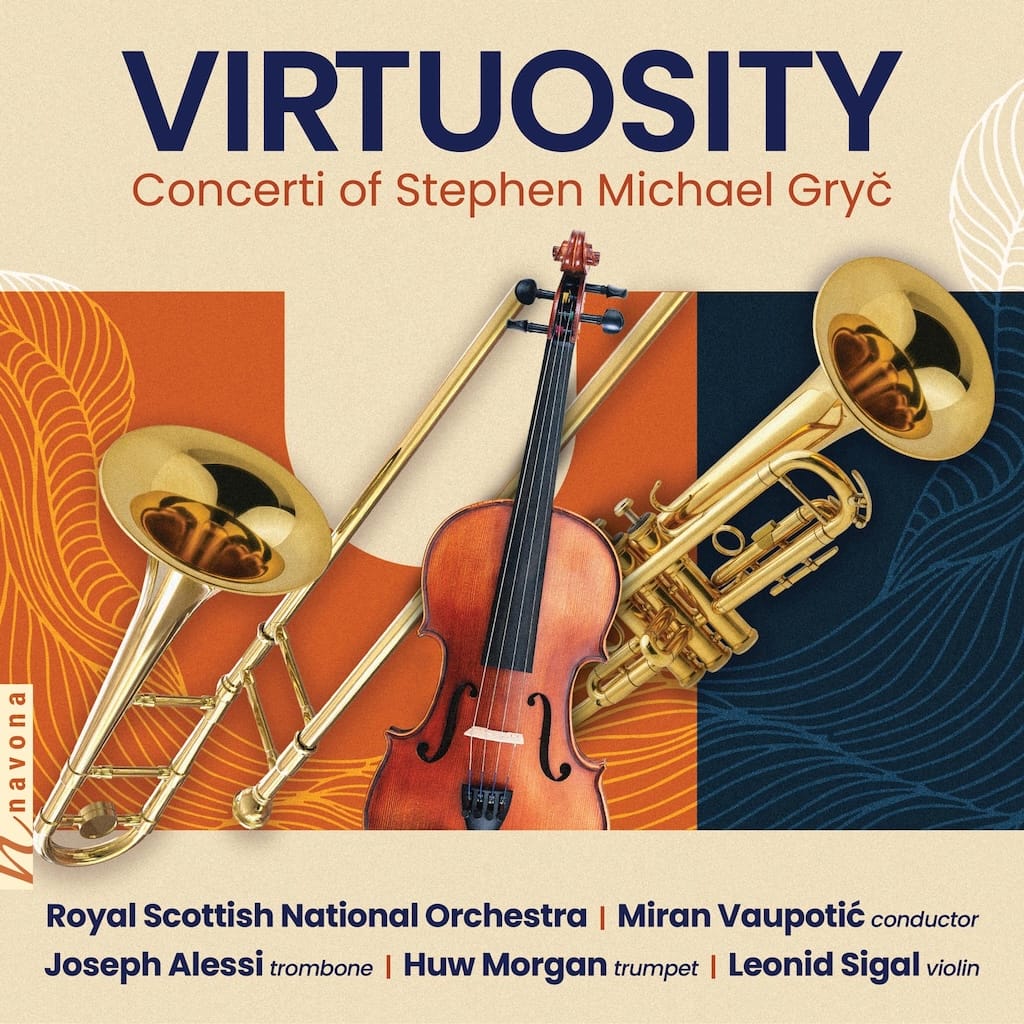
Stephen Michael Gryč has spent a career exploring what instruments can do, not simply as vehicles for musical ideas but as sources of colour, character and expression. His new album, Virtuosity: Concerti of Stephen Michael Gryč, brings together the Royal Scottish National Orchestra under conductor Miran Vaupotić with three distinguished soloists: trombonist Joseph Alessi, trumpeter Huw Morgan and violinist Leonid Sigal.
Released on 7 August 2026 by Navona Records, Virtuosity offers a revealing portrait of a composer whose music sits comfortably within the European classical tradition while resisting easy categorisation. Its tonal language draws on the clarity and formal discipline of earlier traditions, while its instrumental writing and orchestral colours reflect the influence of twentieth-century modernism. There are echoes of neoclassicism and composers such as Prokofiev, yet Gryč's music ultimately speaks in a voice of its own.
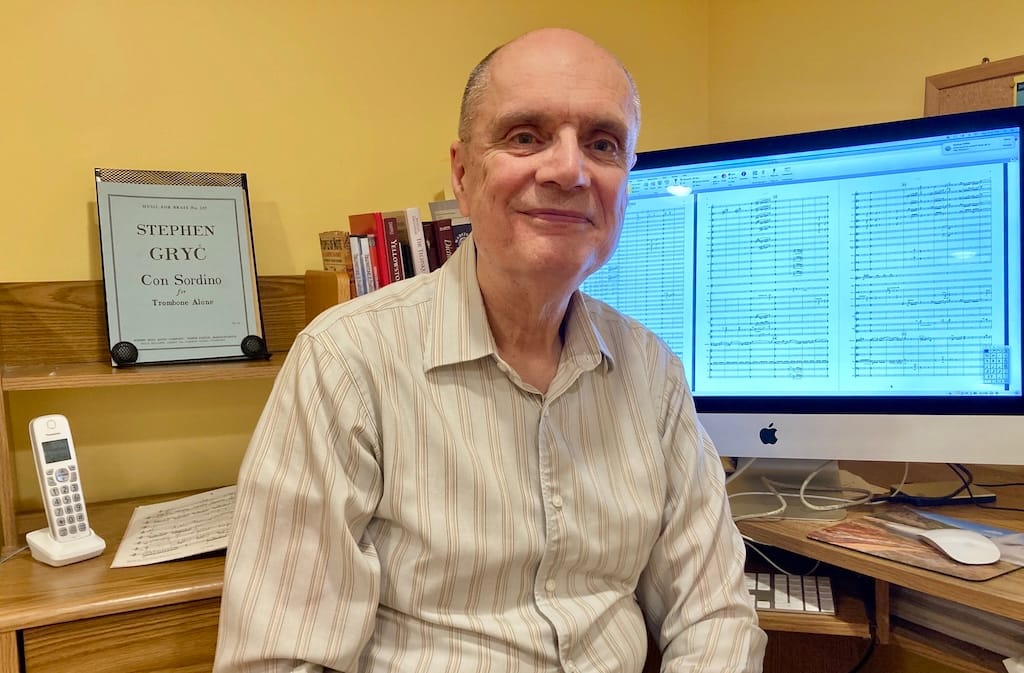
That voice has been shaped by an unusually intimate knowledge of instruments. Gryč himself began his musical life as a trombonist before turning increasingly towards composition, eventually earning a Doctor of Musical Arts from the University of Michigan, where he studied with Pulitzer Prize-winning composers Leslie Bassett and William Bolcom. As Professor Emeritus of Music Composition and Theory at the Hartt School of the University of Hartford, he has also spent decades helping young composers develop their own artistic identities.
His catalogue encompasses virtually every Western instrument and a remarkable range of ensembles, from chamber music to large orchestra. His works have been performed by ensembles including the Minnesota Orchestra, United States Marine Band and American Brass Quintet, while his music has appeared at festivals and conferences across Europe, Asia and the Americas. He has also received commissions from leading instrumentalists including trumpeter Philip Smith, organist Barbara Harbach, flutist John Wion, oboist Humbert Lucarelli, saxophonist Carrie Koffman, as well as Alessi and Sigal.
On Virtuosity, this fascination with the individual instrument and performer comes particularly into focus. The concertos for Alessi and Sigal were written specifically for them, while Morgan joins them as the album's three featured virtuosos. The result is music in which technical brilliance is closely tied to instrumental personality, orchestral colour and melodic expression.
In this interview, Gryč reflects on the relationship between performer and instrument, the composers who shaped his musical imagination, his experience of teaching composition, and his enduring belief in the expressive power of melody.
Nikhil Sardana: Virtuosity naturally suggests technical brilliance, but these concertos also seem deeply concerned with musical personality. When you write for artists such as Joseph Alessi, Leonid Sigal, or Huw Morgan, how much of the music grows from the individual performer rather than the instrument itself?
Stephen Michael Gryč: When talking about instrumentalists, it is difficult to separate the individual from their instrument. The instrument is both an extension of a player’s body and a part of their persona. In my performing days, I considered being a trombonist an essential part of who I was. When I was composing the pieces on this album, I concentrated on the characteristics of the instrument for which I was writing. Of course, I was taking into consideration the high level of technical skill and artistry of which my soloists are capable, but I didn’t know them as individuals that well. I got to know them much better through their playing of my music. The soloists themselves lend their unique personalities to the music they play.
NS: Your music has been described as tonal, yet it avoids sounding nostalgic or stylistically retrospective. How would you describe your own musical language, and how has it evolved over the course of your career without abandoning its core identity?
SMG: My music is certainly in the European classical tradition, and its characteristics relate to many different historical periods. Movements within larger works tend to concentrate on a single affect, as in the Baroque era. I value coherent and elegant forms based on patterns of repetition, as in the Classical period. Expressive melodic lines lead my music, as in Romantic music, and I have an intense focus on instrumental color, as in so much early twentieth-century music. These core values were already formed by the time I began to compose, and my growth as a composer can be defined by an expanding sense of tonality, a refinement of technique, and the growing primacy of expressive, shapely, coherent melodic lines.
NS: Listeners often hear echoes of twentieth-century composers such as Prokofiev while also recognising a voice that feels distinctly your own. Which composers have shaped your thinking most profoundly, and at what point did you feel you had found your own compositional voice?
SMG: There are so many composers that I admire and draw upon for inspiration. A few of them, in historical order: Hildegard, Heinrich Isaac, Bach, Haydn, Mendelssohn, Stravinsky, Bartók, Debussy, Ravel, Britten, Copland. Stravinsky and Bartók were my idols when I first started composing, and then I was drawn to Debussy, who was an inspiration for Stravinsky and Bartók as well. That the early twentieth-century composers (my musical grandparents) are key inspirations must make me a conservative, but I hope that I am an imaginative conservative with my own voice. As I look back over my early work, I mostly find continuity with the music I now write. It was a matter of distilling and refining what was there from the beginning.
NS: Having taught composition and theory for many years at the Hartt School, you've influenced generations of young composers. Has teaching changed the way you compose, or has composing changed the way you teach?
SMG: Intuition plays such an important role in all creative work, but helping young composers start on their own artistic paths demands so much more than telling them to use their intuition. A teacher has to be explicit about what they hear or don’t hear in a student’s work, about what is strong and what seems weak. It took years to become good at putting my own compositional concepts and values into words so that I could give students a helpful critique. This didn’t necessarily change the way I composed, but it did crystallise my practice in my own mind, which allowed me to continually refine my music and gave me the confidence to do so. When reviewing my own work in the midst of composing, I ask myself the same questions that I ask students when reviewing their work. Though what I say to my students comes from my own experience, I never try to impose my own stylistic choices on them. My critique must always support the student’s search for their own artistic voice.
NS: At a time when contemporary classical music often finds itself divided between tradition and experimentation, your works seem to occupy a space that is unmistakably modern while remaining immediately communicative. What do you hope audiences take away from Virtuosity, and what role do you believe melody, tonality, and orchestral colour should play in the future of new classical music?
SMG: When I was a student in the 1960s and ’70s, post-Webernism was in vogue. Musical lines tended to be disjunct melodically and truncated to the level of a motive with just four, three, or even two notes. When presenting their music, composers would timidly and only occasionally admit to writing melodies. I remember an author asking me, “Why do composers apologize for writing melodies? I don’t apologize for writing sentences!” I love all the various components of musical composition (counterpoint, orchestration, form, harmony, etc.), but it is a strong melodic line that initially engages a listener and leads them through a complex work. In general, melody is the most directly expressive part of music. In my music, all the other aspects of composition tend to grow out of melody.