In Conversation with Euchar Gravina: Writing ‘ARIA’ Across Distance
Maltese composer Euchar Gravina discusses ‘ARIA’, a pandemic-born collaboration with violinist Stefan Calleja and the London Symphony Orchestra, reflecting on listening, identity, and how intimacy and distance shape his evolving compositional voice.
In ARIA, Maltese composer Euchar Gravina brings together violinist Stefan Calleja and the London Symphony Orchestra under the direction of Miran Vaupotić in a work that is as much about listening as it is about sound. Conceived during the pandemic through remote exchanges between composer and performer, the piece unfolds as a lyrical dialogue shaped by proximity, distance, and the intimacy of recorded sound.
At just over five minutes, ARIA is compact in scale yet expansive in its expressive reach. Its violin line, almost vocal in character, is echoed and refracted through a responsive orchestral texture, creating a sound world that feels both immediate and reflective. Rooted in a shared Maltese musical sensibility yet realised on an international stage, the collaboration draws attention to questions of identity, memory, and artistic exchange.
Gravina, based in London, has developed a multifaceted practice that spans composition, curation, and artistic leadership. As Artistic Director of St John’s Waterloo and the Waterloo Festival, and as a participant in the London Symphony Orchestra’s Jerwood Composer+ programme, he occupies a distinctive position at the intersection of creative and institutional life. His work, often shaped by close collaboration and an attentiveness to context, continues to explore how music can carry both personal and collective resonance.
In this conversation, Gravina reflects on the making of ARIA, his evolving compositional voice, and the interplay between listening, collaboration, and identity in his work.
Nikhil Sardana: ARIA emerged from remote exchanges during the pandemic. How did that unusual mode of collaboration shape the musical language of the piece, particularly its sense of intimacy and dialogue?
Euchar Gravina: For most of the writing process, Stefan and I connected by exchanging recordings made on a phone or laptop, or via video calls, often without high-quality sound. In a sense, his playing reached me in a very direct and private way, through headphones rather than in a rehearsal room or concert hall. Even the placement of the phone, with Stefan effectively playing into the device rather than into a large space, meant I was hearing him in a kind of “closed-mic” setting.
I think this encouraged a different kind of listening, and therefore a different kind of writing. I spent a great deal of time sitting with the short phrases we exchanged. These were mostly pastiche-like melodies I wrote for him, with the aim of better understanding his phrasing and interpretative approach. Repeated listening, sometimes manipulating the recordings by reversing or layering them, allowed me to pick up nuances I might otherwise have missed. That process sharpened my listening and, in turn, shaped the intimacy of the work.
NS: The violin line in ARIA feels almost vocal in its phrasing. Were you consciously drawing on operatic or song traditions, or did this “singing” quality emerge more intuitively in the writing?
EG: It’s a bit of both. I didn’t initially set out to write a piece specifically about song or vocalisation, but as I engaged more deeply with Stefan’s playing and returned repeatedly to the recordings, it quickly felt like the natural direction.
Practical constraints also played a role. Thinking in terms of an “aria” or “song” suited a work that needed to fit within five minutes. Around the same time, I was exploring some of the earliest available recordings of operatic singing, which later fed into Medea, a piece for piano and tape from 2022. That immersion, combined with the expressive parallels between the singer’s voice and Stefan’s playing, led me to treat the violin very much as a singing voice.
NS: Your close exchange with Stefan Calleja seems central to the work. How did his playing and musical personality influence the final shape of the piece?
EG: Very much so. From the outset, this was a work commissioned for Stefan, so it felt natural to write with and around both his playing style and his musical interests. Because of this, I didn’t begin with a fixed sound-world in mind, which is often my approach elsewhere, but instead kept the process as open as possible.
I knew he was particularly drawn to mid- to late-19th-century violin music, broadly speaking the Romantic repertoire, so I leaned into that. It remains a living tradition in Malta, not only in concert halls but also in liturgical and orchestral contexts, where Stefan and I often crossed paths.
His playing itself offered direction. The way he uses vibrato and portamento, reimagining these so-called “old-school” techniques, became a guiding force. I allowed that to shape the writing, with pitch and harmony following from those expressive qualities rather than preceding them.
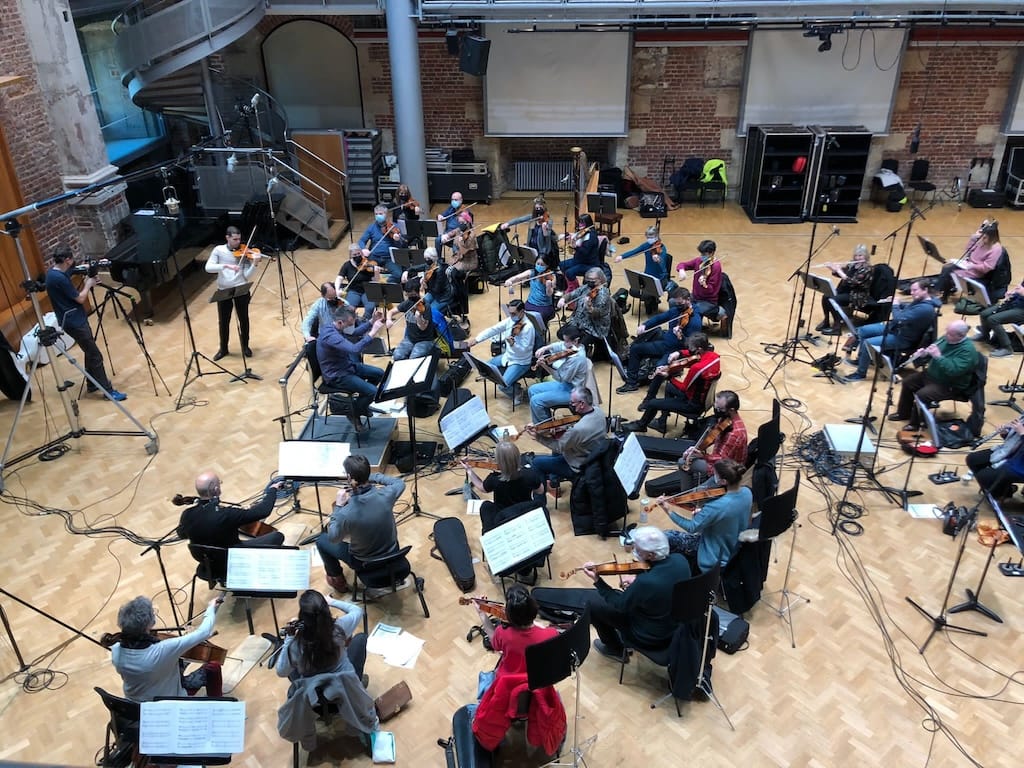
NS: The orchestra in ARIA does not merely accompany but seems to reflect and transform the violin’s material. How did you approach balancing clarity of the solo line with the richness of orchestral texture?
EG: I spent a long time with the main phrase, focusing solely on the melody before thinking about the orchestra. Everything else grew from that starting point. Much of the harmony and texture emerged from working with the harmonic partials of recorded violin lines, layering, reversing, and carefully transcribing them.
In this way, the orchestral writing was always conceived as something that plays with the violin, reflecting and shadowing the solo line rather than stepping forward in competition.
NS: You have worked across orchestral, choral, and interdisciplinary contexts, often alongside your role as a curator and artistic director. How do these different strands of your practice inform your compositional voice?
EG: Working as a curator has made me far more conscious of how my music is received. I find myself thinking not only about the sound itself, but also about context, the venue, the programme, and the audience. More broadly, it has made me aware of the cultural baggage my work carries.
For a long time, I tried to keep these roles separate. The tension between programming other people’s work and composing my own felt difficult to reconcile, as they require different modes of thinking and attention. I’m not sure I’ve fully resolved that tension, but I’ve stopped trying to avoid it and have instead begun to lean into it.
This is partly what drew me to my current role with the London Symphony Orchestra’s Jerwood Composer+ scheme, where the brief is precisely to engage with both: curating projects while developing new compositions. It’s been a rewarding experiment in allowing the two practices to inform one another.
NS: As a Maltese composer working internationally, how do you think about identity in your music? Is it something you consciously engage with, or does it emerge more organically?
EG: It’s a mix of both. There are times when I consciously engage with it, leaving space for it to emerge because the context invites it. In this piece, for example, the Maltese relationship to operatic and liturgical traditions was part of the thinking. Similarly, in a recent work for the LSO, Dwawar, I drew on recordings of Maltese music from the 1930s as a way of reconnecting with childhood sound memories.
At other times, I only recognise these influences in retrospect. What interests me is how growing up and listening in Malta has shaped my ears. That sound world is inseparable from how I hear and write, and distance has perhaps made me more aware of it.
NS: Your leadership roles at St John’s Waterloo and the Waterloo Festival have reshaped those platforms in meaningful ways. How has this curatorial work influenced the way you think about programming and composing today?
EG: Significantly. Both St John’s Waterloo and the Waterloo Festival are about opening up a heritage space to a wider public, from dedicated concertgoers to those who may never have encountered such a space before. They also place strong emphasis on community arts alongside classical music.
This work has drawn me towards projects that are both artistically rigorous and accessible, inviting people in as participants or listeners. A good example is a series of Pauline Oliveros Deep Listening workshops we ran last summer, in partnership with an experimental arts organisation and a creative mental health charity. They were demanding but also deeply inclusive, meeting people where they were.
As a composer, this has made me more attentive to dramaturgy. I now think more carefully about the “who”, “where”, and “what” while writing. It has also made me more open to the personal and the intimate, particularly experiences that feel private yet widely recognisable.
NS: Looking ahead, what kinds of projects or ideas are currently shaping your artistic direction, and where do you see your work evolving in the next few years?
EG: I’m increasingly interested in bringing together my curatorial and compositional work, developing projects that integrate both. In terms of writing, I’ve become particularly drawn to working with recordings, both historical and contemporary, as starting points for new pieces. There’s something compelling about their imperfections and the way time reshapes them.
This approach has helped me engage more deeply with how I listen, focusing not only on pitch and harmony but also on the character and narrative embedded in specific performances.
In the more immediate future, I’ll be working on the next edition of the Waterloo Festival this July, as well as a concert with LSO musicians at LSO St Luke’s in London this October, which will include a new composition currently in progress.