History, Mystery and Music: The World of Composer Jamie Wilkins
Composer, conductor and arranger Jamie Wilkins discusses his creative process, the influence of history and storytelling on his music, recording with the London Symphony Orchestra, and the remarkable experiences that have shaped his musical journey.

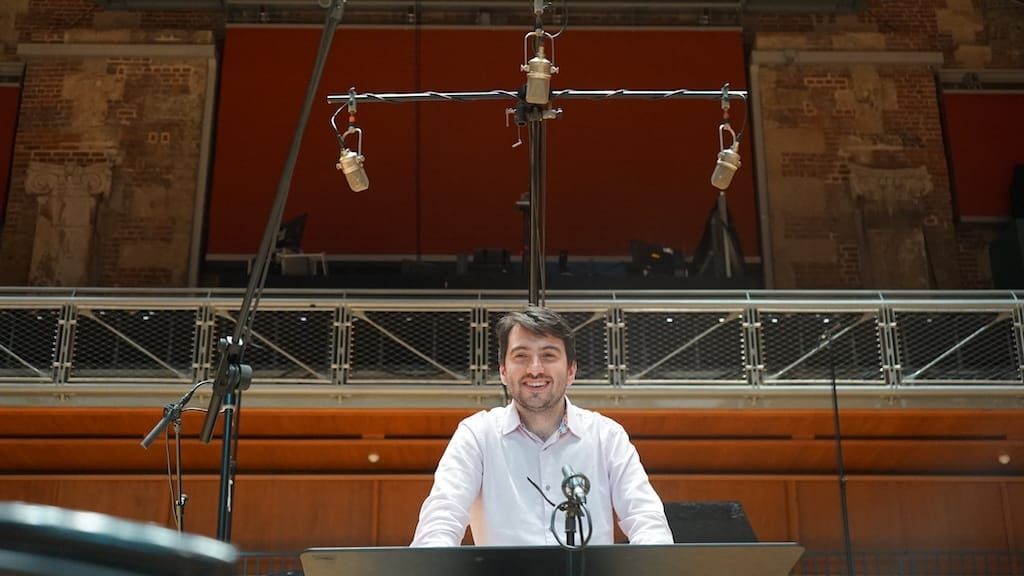
Jamie Wilkins is a British composer, conductor, arranger and multi-instrumentalist whose work bridges the worlds of classical music, film, television and historical storytelling. A graduate of Goldsmiths, University of London, he began composing in his early teens and has since developed a distinctive musical voice shaped by a lifelong fascination with history, literature and place.
Best known for composing the music for the television series Ghostcircle, Wilkins has travelled extensively throughout the United Kingdom and Europe, creating scores inspired by castles, historic houses, museums and the people connected to them. His music draws on a wide range of influences, from Baroque traditions and British cultural history to contemporary orchestral and cinematic writing.
In 2024, Wilkins reached a major milestone in his career when he recorded and conducted his debut album Primo with the London Symphony Orchestra at LSO St Luke’s in London. The album reimagines music originally written for Ghostcircle, transforming it into a collection of twelve orchestral works that showcase both his melodic gift and his versatility as a composer.
In this interview, Wilkins reflects on his creative process, the lessons learned from his musical education, the inspiration he finds in historic locations, and the experiences that have shaped his journey from young composer to recording artist and conductor.

Serenade Team: Your work spans composition, conducting, arranging, and performance. Which role feels most natural to you today, and how do these disciplines influence one another in your creative process?
Jamie Wilkins: Composition feels the most natural to me. It is something I take very seriously and devote a great deal of time to, with each new idea emerging in its own unique way. I do not need to be sitting at a desk or at the piano to compose; in fact, I often write music entirely in my head, which is particularly useful when travelling. Inspiration can strike at the most unexpected moments.
The practical disciplines of performance and conducting influence me enormously and shape many of my creative decisions. I approach a piece from the perspective of a listener, performer and conductor simultaneously. I constantly ask myself: Is this playable? Does it fit comfortably under the fingers? If it is an orchestral work, is it realistic to expect the strings to perform a particular rhythm in unison? And perhaps most importantly, how would I conduct this music?
In my view, there is little value in writing music that is impossible to perform. It is far better to create music that is well crafted and idiomatic for the instruments involved. I have spent years studying not only composition but also orchestral conducting and orchestral performance in order to gain practical insights that I now draw upon when writing. That experience enables me to approach music from multiple perspectives and has helped me become a more versatile musician.
ST: You began composing music in your early teens. Do you remember the first piece you wrote that made you think seriously about becoming a composer?
JW: Very little of my earliest music survives, but there was one piece that made me begin to think seriously about becoming a composer. It was a short piano work, which I believe was called Prelude, written when I was fifteen or sixteen years old. Compared with my earlier efforts, it felt more mature and, in many ways, closer to the musical language I use today.
That piece gave me my first genuine sense that I might be able to pursue composition professionally. The feeling was reinforced when the team behind Ghostcircle approached me and asked to hear some examples of my work. In my enthusiasm, I sent them the piano prelude and, to my surprise, they loved it. Soon afterwards, I received my first commission to write a theme tune for their videos, which later became the foundation for my work on the television series.
As you can imagine, I was absolutely thrilled. That initial commission led to further opportunities, and it was the positive response to that small piano piece that ultimately set me on the path I am still following today. In many ways, it was the first step on a journey that would eventually lead to the recording of my debut album, Primo.
ST: Your music for the TV series Ghostcircle blends atmosphere, storytelling and history. How do you approach composing for places and narratives that already carry such strong emotional or supernatural associations?
JW: My approach is really twofold. Firstly, I am part of the filming team on location, which allows me to absorb the atmosphere, history and character of a place first-hand. Secondly, as a composer, it is my responsibility to transform those impressions into music—not only to support the story being told but also to add another emotional and dramatic layer to it.
Every location has its own identity and character. Sometimes inspiration arrives while I am filming on location; at other times it emerges once I sit down to write. I take into account everything connected to the place, including its historical period, architecture, purpose and any notable figures or stories associated with it.
All of this information, together with my own impressions and emotional response, shapes the creative process and ultimately influences the style of the music. Historical details often provide the starting point. For example, the music I wrote for Handel's house in Mayfair was composed in a Baroque style. Towards the end of the piece, I included a brief riff inspired by Jimi Hendrix because he famously lived next door to Handel in the 1960s. The connection between those two musical worlds became an important source of inspiration.
Similarly, when writing music for Schloss Erichsburg in Germany, I was fascinated by its history as a centre for breeding cavalry horses during the First World War. That history informed the entire composition. The result was a highly militaristic piece featuring horn calls, jarring rhythms and a sense of relentless forward movement. The horses themselves became an important source of inspiration and helped shape the character of the work.
There is also the paranormal dimension, which naturally interests me. I have been involved in paranormal investigation for nearly twenty years, and that is often one of the reasons we are filming at a particular location. Having said that, I try to avoid the clichés often associated with paranormal television music. Rather than simply creating something designed to sound frightening, I prefer to explore the emotional weight, history and stories connected to a location. For me, that is the most effective way of capturing its true character and atmosphere.
ST: You have travelled across the UK and Europe filming in castles, historic houses and unusual locations. Was there one place that profoundly affected you musically or inspired a composition in an unexpected way?
JW: Yes, absolutely. There have been many places that have left a deep impression on me, and I have been incredibly fortunate to visit and film in some remarkable historic locations. However, one experience in particular has stayed with me throughout the years.
We were filming at Ross Castle in County Meath, Ireland, when something unusual happened. While exploring the castle with its owners, I suddenly heard beautiful flute and harp music drifting through the building. It sounded as though it was being performed somewhere within the castle itself. The music lasted only ten or fifteen seconds before gradually fading into silence.
Naturally, I tried to find a rational explanation. I asked everyone present whether they had heard it and checked for possible sources of sound. However, we were miles from the nearest neighbours, and there were no televisions, radios or other obvious explanations.
I was only eighteen or nineteen at the time, and the experience made a profound impression on me. It filled me with a sense of wonder and joy that I have never forgotten. Somehow, I managed to remember the melody, and when I returned home, I wrote it down. It is only a short piece, but it has since appeared in Ghostcircle episodes and promotional material, while also inspiring other compositions.
Looking back, I feel nothing but gratitude for having experienced something so beautiful. Was it spirit music, or was it simply a product of my imagination? I will leave that question for others to answer.
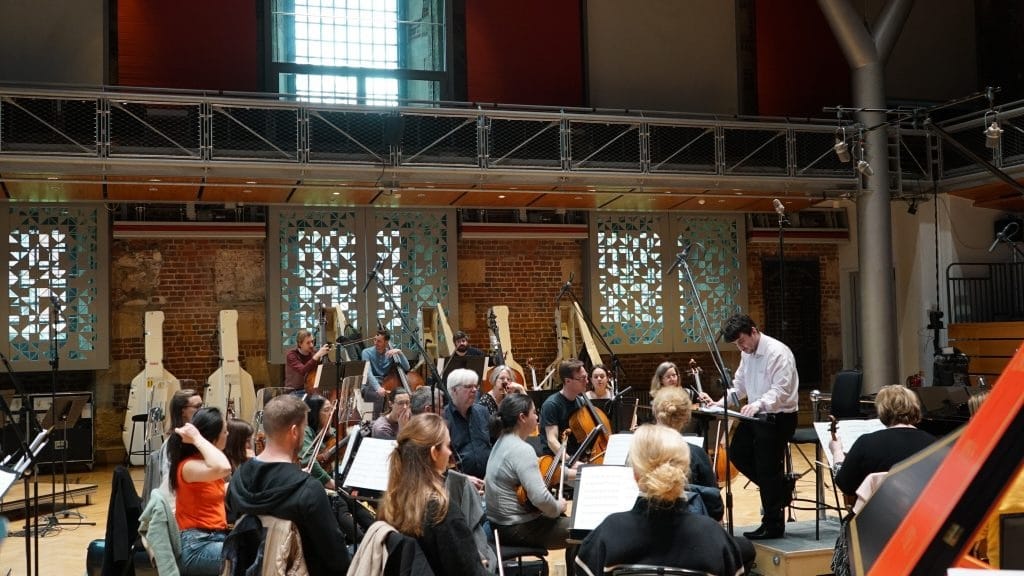
ST: Recording your debut album Primo with the London Symphony Orchestra at LSO St Luke’s must have been a major milestone. What was it like conducting your own music in that setting?
JW: Working with the London Symphony Orchestra was both the most thrilling and the most terrifying experience of my life. It was an extraordinary privilege to stand in front of musicians who are among the finest in the world and hear my own music brought to life by them.
One of the first things that struck me was walking into the hall and seeing it fully prepared for recording, with microphones and equipment positioned throughout the space. I remember thinking to myself, “Yes, this is really happening.”
When it was finally time to conduct, I walked up to the podium with my heart pounding. As soon as the orchestra began to play, the sound that came back was overwhelming in the best possible way. It felt almost like a physical force. It took a few moments to adjust to hearing music that had existed only in my imagination suddenly become a living, breathing reality.
Once those initial nerves subsided, a rapport began to develop between myself and the orchestra, and that was when the real magic happened. Hearing music that had lived in my head for years performed by musicians of such exceptional skill was an immensely emotional experience.
As it was my first professional recording session, our audio engineer, Jonathan Stokes, guided me through the process and helped ensure everything ran smoothly. His experience and calm approach took much of the pressure away. The entire project was intense, exciting and deeply moving. It represented the culmination of years of work, determination and belief, and it is an experience that will remain with me for the rest of my life.
ST: Your compositions move between Baroque influences, cinematic writing, minimalism and contemporary orchestral textures. How would you describe your own musical language or signature style?
JW: That is a difficult question to answer because my musical language is constantly evolving. It has taken decades of study, experimentation and life experience to discover my own voice, and I still feel that it continues to grow and develop.
At its heart, my music is rooted in the Western classical tradition and in the idea of storytelling through sound. Over the years, my writing has become increasingly introspective and emotionally nuanced, while retaining a strong sense of drama and atmosphere. There is often a distinctly Gothic quality to my work, which naturally lends itself to cinematic writing.
I tend to write the kind of music that I would want to listen to myself. My tastes are eclectic and range from early jazz, rock and pop to medieval, Renaissance and classical music. I have absorbed influences from many different styles and periods, taking elements from each and adapting them into something that feels personal.
What attracts me most is music that takes the listener on a journey. For me, music is storytelling in its purest form. It should move, evolve and develop rather than remain harmonically or rhythmically static.
There are two contrasting sides to my current style. One is adventurous, energetic and cinematic, often driven by rapid harmonic and rhythmic movement and dramatic orchestral colours. The other is more introspective and minimalist, particularly in my piano music, where ideas unfold gradually and organically over time. Although I work across a wide variety of genres and styles, atmosphere, emotional depth and narrative remain at the centre of everything I write.
ST: Having studied at Goldsmiths, University of London and worked with composers and conductors from very different traditions, what lessons or philosophies have stayed with you most strongly?
JW: Studying at Goldsmiths gave me the opportunity to work alongside a diverse range of composers and performers from both classical and contemporary traditions. One of the most important lessons I learned there was that there is no single “correct” way to approach music. Instead, I was encouraged to develop my own voice and discover my own way of working.
The person who has had perhaps the greatest influence on my development is the composer and conductor Paul Sarcich, whom I first met at Morley College London. Paul has consistently encouraged me to challenge myself creatively and to take artistic responsibility for my work. Through him, I came to understand that every composer, conductor and performer possesses their own process, perspective and musical identity. One of the most valuable lessons he taught me was to absorb what resonates with you and then make it your own.
Another important lesson is that composition and conducting are crafts. Inspiration is essential, but it is no substitute for discipline, technique and hard work. Brahms famously said, “Without craftsmanship, inspiration is a mere reed shaken in the wind,” and I have always found great truth in that statement.
Perhaps the most practical lesson I have learned is the importance of self-editing. I like to allow ideas to flow freely during the creative process and then return to them with a more critical eye. Creativity is not simply about generating ideas; it is also about refining, organising and developing them into something coherent and meaningful. Music, after all, is organised thought expressed through sound.
I have also learned the value of preserving ideas, even those that initially seem unsuccessful. Themes, sketches and fragments often find new life years later in entirely different contexts.
More broadly, I believe it is important to remain open-minded and authentic. I never want to become trapped by a particular style, expectation or way of thinking. Curiosity, exploration and growth are essential, but they should always be balanced with maintaining an honest artistic voice. These principles have helped me become a more adaptable musician and have contributed greatly to the depth and character of my music.
ST: Many of your works are inspired by history, literature and architecture, from Handel’s house in Mayfair to castles in Ireland and museums in Prague. What draws you so deeply to historical spaces, and how do they shape the emotional character of your music?
JW: I have always been fascinated by history and historic places. They seem to ignite my imagination in a way that few other things can. Growing up in a Victorian terraced house in London probably played a part in that fascination, as I was surrounded by a sense of the past from an early age.
To me, as both a composer and paranormal researcher, historical sites are far more than simply buildings. They contain stories, memories and emotional echoes that continue to resonate long after the people connected to them have gone. When I visit these places, I often feel as though I am absorbing those layers of history and translating them into music.
In many ways, I see myself as an interpreter of atmosphere. My role is to transform the emotions, drama and stories associated with a location into sound, whether those emotions are romantic, tragic, mysterious or inspiring. For example, when we filmed at Ross Castle in County Meath, Ireland, I learned the story of two lovers who eloped by boat and tragically drowned in the lake beside the castle. The emotional power of that story became a significant influence on the music I wrote.
I also take into account the country, culture and historical period associated with each location. One example is The Alchemists, written for an episode filmed at the Museum of Alchemy in Prague. For that piece, I drew inspiration from Czech folk traditions, the sound of the cimbalom, and the remarkable stories and legends associated with the museum itself.
Another example is The Bell, written for an episode filmed at the Bell Inn in Whitechapel, East London. The inn has long been associated with Jack the Ripper and two of his victims, and the atmosphere of the location was incredibly powerful. Imagining Victorian Whitechapel, with its fog-filled streets and dark history, became an important influence on the piece. The work, which appears on my album Primo, is dedicated to the memory of Jack the Ripper’s victims.
This is why each composition is different. Every piece is shaped by the unique location, history and story behind it. Whether I am writing about a castle, museum, manor house or old public house, those places become active participants in the creative process. They provide the emotional foundation upon which the music is built and help determine the character of the work as a whole.