Stravinsky and Debussy: A Mutual Admiration
Though often viewed as representatives of contrasting musical worlds, Claude Debussy and Igor Stravinsky shared a remarkable artistic bond. Their mutual admiration fostered a creative exchange that influenced modern music and connected two of the twentieth century’s greatest composers.

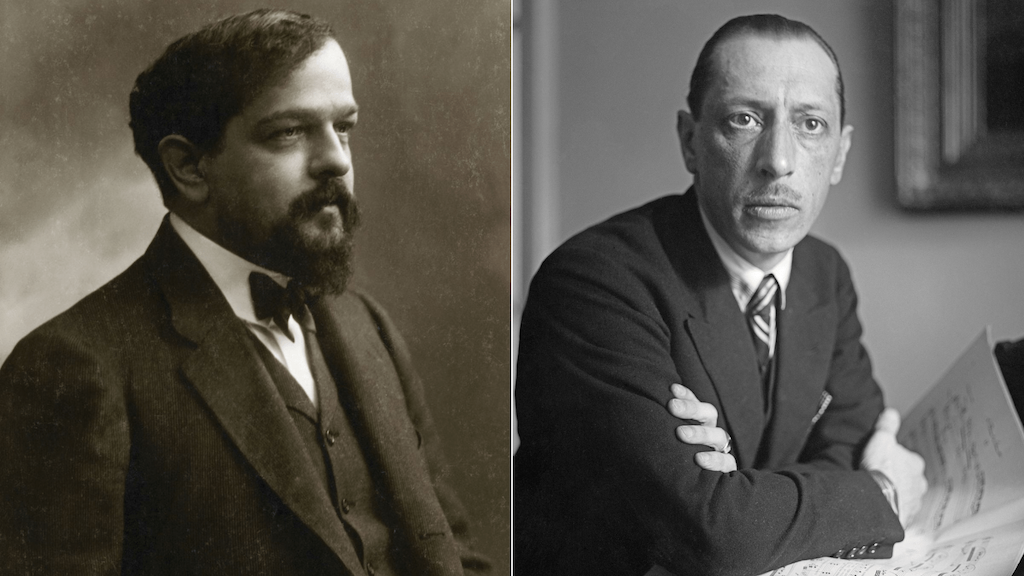
There is something quietly extraordinary about the friendship between Igor Stravinsky and Claude Debussy. Two composers separated by nationality, temperament and generation, they nonetheless recognised in each other a kindred impatience with the conventions of their age.
Their relationship, which flourished in the years immediately before the First World War, stands as one of the most fertile and undersung creative partnerships in the history of Western music. It was not without its complications, and it did not survive entirely intact. But for a precious handful of years, these two men were genuinely, generously devoted to each other's work, and the music each produced in that period bears unmistakable traces of the encounter.
A Meeting of Minds in Paris
They first met in 1910, when Stravinsky was an almost unknown quantity from St Petersburg and Debussy was the most celebrated and controversial composer in Paris. Sergei Diaghilev, impresario of the newly formed Ballets Russes, had taken a risk on the young Russian, commissioning from him a score to accompany a new ballet on the legend of the Firebird.
When L'Oiseau de feu received its premiere at the Paris Opera in June of that year, Debussy was in the audience. The two men were introduced backstage, and something evidently clicked. Within months they were meeting regularly, playing through scores together at the piano, and writing to each other with a warmth that went well beyond professional courtesy.
What Debussy Heard
What Debussy heard in Stravinsky was a freshness of invention that he found almost nowhere else in contemporary music. He was particularly transfixed by the ballet scores that followed L'Oiseau de feu in quick succession: Petrushka in 1911 and then, most electrifyingly of all, The Rite of Spring in 1913.
It is worth pausing on this last point, because Debussy's response to The Rite tells us a great deal about his generosity as a listener. Most of his Parisian contemporaries were baffled or appalled by its ferocity. Debussy, by contrast, had already heard the score in private before its infamous premiere, when Stravinsky played it through on the piano with him taking the secondo part in a four-hand arrangement.
He reportedly sat in a kind of stupefied admiration, smoking cigarette after cigarette. He was not blind to the violence of the work's idiom, but he understood, as few others did at the time, that this violence was purposeful, structurally integral, and profoundly original.
What Stravinsky Absorbed
Stravinsky's admiration for Debussy was equally ardent, if perhaps more complicated by his own ferocious ambition. He absorbed Debussian orchestration deeply: the veiled, suspended harmonies, the static shimmer of texture, the willingness to let a chord breathe without immediately seeking resolution.
L'Oiseau de feu, for all its debt to Rimsky-Korsakov, already shows the younger composer listening hard to works such as La Mer and Pelléas et Mélisande. The fluid, iridescent transitions in that first ballet score are not Russian in character; they belong to a French aesthetic that Stravinsky had absorbed with remarkable speed and made very much his own.
He later denied Debussy's influence rather strenuously, which is itself suggestive. Composers do not generally bother denying the influence of artists who have not shaped them.
Against Wagner: A Shared Creed
The two men also shared a driving need to move beyond German romanticism, especially in its Wagnerian form. This was not a straightforward rejection; both had complicated histories with Wagner's legacy, and Debussy in his early career had been genuinely drawn to Wagnerian harmony before working hard to escape its pull. Stravinsky's relationship with Wagner was similarly ambivalent, marked by public dismissiveness that sat alongside a deeper, privately acknowledged respect.
What united them was not contempt so much as a shared conviction that the Wagnerian path had reached its limit. Where Wagner had sought to dissolve individual musical elements into an undifferentiated emotional flux, both Debussy and Stravinsky were drawn to clarity, to surface, to the thing itself rather than what it supposedly symbolised. Debussy eventually worked out a French musical language that refused the chromatic sprawl of Tristan on its own terms.
Stravinsky, for his part, would spend much of his later career elaborating a neo-classical aesthetic grounded in the transparent textures of the eighteenth century. These were different solutions to a shared problem, and their friendship was partly a confirmation that the problem was real.
Two Men at a Piano
One of the most touching documents of their relationship is the four-hand piano arrangement of three movements from The Rite of Spring that the two men played together, which Stravinsky later described as one of his most cherished musical memories.
There is something wonderfully intimate about this image: the two most significant composers of their age, bent over a single upright piano in a Paris apartment, feeling their way through a score that would shortly shake the foundations of Western music.
Debussy's willingness to sit at the keyboard with a composer twenty years his junior, and to take the lower part while Stravinsky played the upper, speaks to a quality of attentiveness that is rarer in artistic life than one might hope.
The War and Its Aftermath
The friendship survived the premiere of The Rite, with its notorious riot, but it did not survive the war entirely unscathed. By 1914 they were seeing less of each other, and the easy intimacy of the pre-war years grew harder to sustain across the upheaval of the conflict.
By the time Debussy died in March 1918, weakened by cancer and ground down by the long misery of the war, the two men had not quite recaptured what they once had. The news of Debussy's death profoundly affected Stravinsky, who in later life spoke of it as a loss he never fully absorbed.
He dedicated his Symphonies of Wind Instruments, completed in 1920, to Debussy's memory. The work's austere, processional quality, so different from anything that preceded it in his output, suggests that the dedication was more than a formality. It reads, in places, like genuine grief rendered in sound.
The Value of Being Understood
What remains instructive about this friendship, a century on, is the quality of attention it demanded from both parties. Stravinsky and Debussy were not simply generous to each other in the vague, back-slapping manner of artistic acquaintances. They listened to each other's music with the focused, technical alertness of professional craftsmen who understood exactly what was at stake in every harmonic decision.
Their admiration was specific, grounded in detail, and the more valuable for it. Debussy did not merely think that The Rite of Spring was impressive in a general way; he grasped precisely what Stravinsky had done with rhythm and with the relationship between melody and mass. Stravinsky did not merely admire the shimmer of Debussy's orchestration; he understood how it was constructed and what it made possible.
This is, in the end, what distinguishes a creative friendship from a merely sociable one. The two men gave each other something that cannot easily be found elsewhere: the experience of being genuinely understood by someone whose standards are as high as one's own.
In the brief, brilliant years before the war scattered them, Stravinsky and Debussy seem to have found in each other exactly that. The music they wrote during that period suggests that it mattered enormously, and that it is worth celebrating still.