Can AI Truly Create Music? The Human Emotions Behind Musical Creativity
AI can generate melodies, imitate great composers and transform music production, but can it truly create? This essay examines the boundaries between imitation and creativity, exploring emotion, authorship and the future of human musical expression.

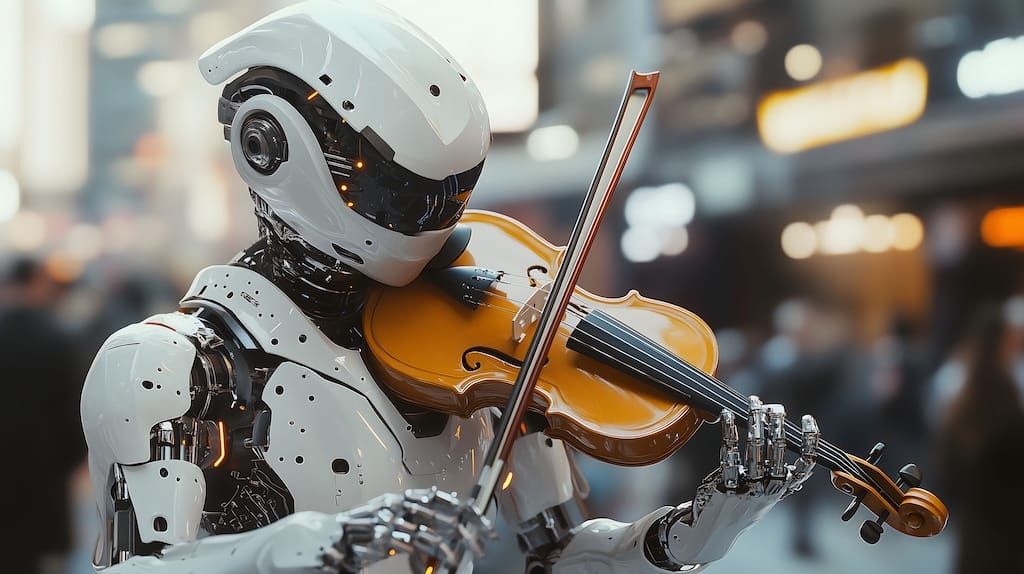
“If music be the food of love, play on.” I cannot say how the good Duke in Twelfth Night would have reacted if he knew that the lute playing mournful melodies was actually AI-generated. What I can say is that such AI-generated melodies would not arise out of love, melancholy, loss, desire, hope, enchantment, or any other human emotion, because AI is neither human nor sentient. This is an obvious point, but bears repetition given the human qualities of mind and intelligence often attributed to AI. While AI is a creation of human intelligence one needs to be careful not to project humanity onto AI.
AI is not an act of God or a force of nature. Given careful curation and handling AI can be used to benefit humankind. Allowed to run amok or morph into superintelligence, it represents a threat to some of the fundamental aspects of what it means to be human. One of these is music. Across time, geographies, and cultures humankind has created music, whether monophonic, homophonic, pentatonic, free-ranging, or eschewing melody and tunefulness altogether. Music transcends boundaries and constitutes a specialist language in itself. It is possible to appreciate a song sung in a language one does not understand because of its appeal to sensibilities shaped over centuries by human creation and exposure to music. Our neural networks respond to music in ways that AI cannot (its networks are complex, but algorithmic), and music is therapeutic, calming, opening minds to hitherto unimagined worlds. A specialist in classical music will delve into the intricacies of harmony or rhythm, but that does not exclude a non-specialist from listening to and taking pleasure in that listening experience.
Music arises out of contexts. Thus Chopin’s “Raindrop Prelude” is a haunting rendition of his awareness of impending, untimely death. Or Robert Schumann’s “Widmung” expresses the depth, intensity, and colours of his love for Clara Schumann. Without these human contexts and emotions translated into notes that are precise and yet open to infinite interpretation, music is mechanical reproduction. Yet these are shaped by statistical patterns rather than lived experience. They may emulate musical language remarkably well, but they cannot draw upon memory, grief, joy or personal imagination in the way human composers have throughout history. AI can assimilate the entire corpus of Western Classical music, reproduce it, and ‘compose’ in the manner of a Mozart or a Bach, but these are not human compositions, they are but pale imitations. The mechanical reproduction of music goes against the essence of music which is based on inspiration, feeling, and emotion. These feelings and emotions are not just that of the composer, but of the pianist or violinist or cellist who interprets that music. Every rendition of Bach’s cello suites or Beethoven’s sonatas is different, because the players bring their being, their presentness to the playing of the piece. This delicate, intimate, practiced, emotional relationship between the composer, his creations, and the players cannot be mechanically reproduced. It is the ineffable quality of human creation that no AI can quite capture, yet.
In this sense, AI-generated music is a paradox, it is an imitation, possibly a fake rendition, and a pretence to music that does disservice to one of the most complex creations of humankind. There is no doubt that AI can generate music. The fakes and clones with which streaming services such as Spotify have been inundated is proof of that. But generation and creation are different. Creativity is slow, painful, human and the processes are not always understandable. I wonder how composers create these complex tapestries of emotion, feeling, perfection – each note in its place, each cadence perfect, creations that defy time and place? We can outsource our creativity to AI but at the cost of our humanity, because AI is an aggregator, it functions on algorithmic bias, it is not yet capable of the quirks of genius and humanity that makes great composers great.
AI-generated music raises obvious issues regarding creativity and copyright. As AI hoovers up entire corpuses what happens to the human creators of music? Are they merely enablers whose music can be mechanically reproduced, with perhaps a nod by way of copyright monies to the creators? Does copyright matter anymore, not only in a legal sense, but in terms of moral and ethical attribution? Does a mashup of Mozart and Haydyn, or Purcell and Bach even count as classical music? As AI cannibalizes songs, tunes, melodies, etc. and churns out machine music, it will have a deleterious effect on creativity and on music listening. AI can flatten or perfect imperfections in pitch or voice modulation, but perhaps it is these imperfections that make the song human and attractive.
As with every stage in human technological progress there is great hype and moral panic surrounding AI. The truth, as always, lies somewhere in between. AI can serve as a collaborator and enhancer in music production. It can analyse vast amounts of data and help researchers, whether they be musicologists or performers. It can serve to create permanent repositories of world music, a global musical archive. The debate, therefore, is not whether AI should be excluded from music altogether. Many composers already use AI as a tool to explore harmony, orchestration, and musical ideas. Like the piano, the recording studio or the computer before it, AI can assist the creative process. The question is whether it remains a servant of human imagination or begins to replace it.
AI is currently biased toward the global north and it needs to incorporate musical traditions from non-western contexts such as India, China, or Japan. AI can help to teach music to differently abled persons. What AI cannot do – at least not yet – is create a truly human song or melody or symphony or raga.
When NASA launched the Voyager spacecraft into deep space, it included the Golden Record containing some of humanity's greatest artistic achievements, among them a performance of music by Bach, offering any future discoverers a glimpse of who we are. As Voyager continues its journey, humanity grapples with both the possibilities and challenges presented by AI. It is not our master but our creation, and the responsibility lies with us to ensure that technology enriches, rather than diminishes, our shared musical heritage.