Netflix’s 'Four Hands, Two Sonatas' Is Bringing Classical Music to a New Generation
Netflix’s 'Four Hands, Two Sonatas' brings the intensity of elite classical piano into the K-drama spotlight, using rivalry, friendship and the intimate art of four-hand playing to make a specialised musical world accessible to new audiences.

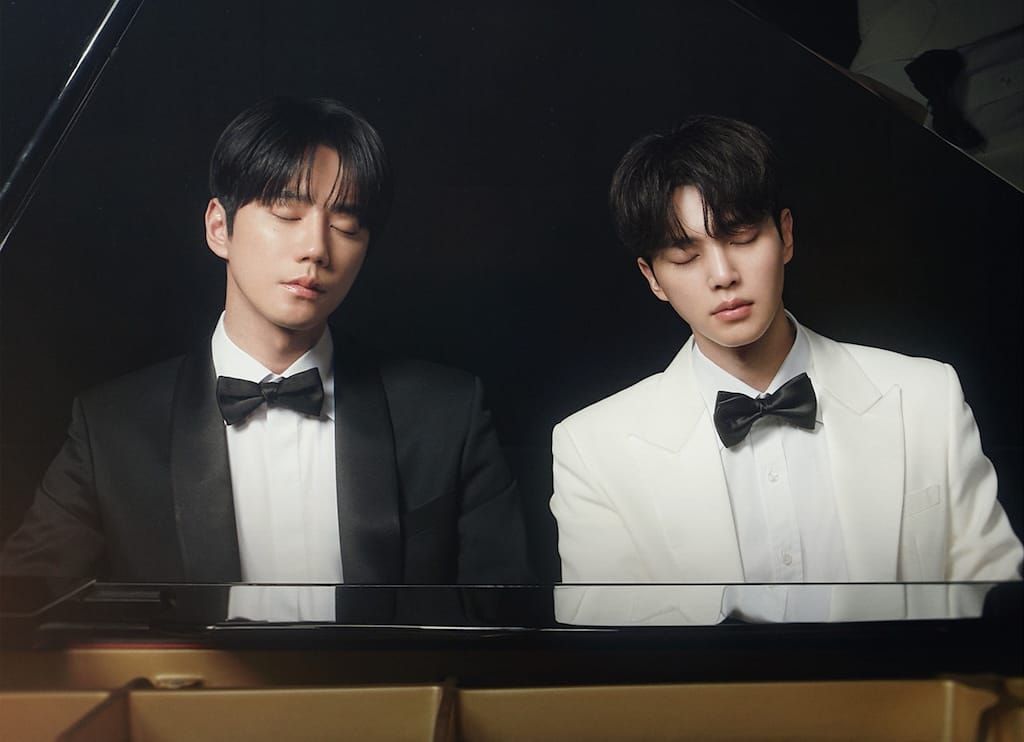
There is something inherently cinematic about two pianists sitting at the same instrument. Their shoulders almost touch, their hands cross and separate across the keyboard, and a single musical line can suddenly become the product of two minds, four hands and an extraordinary degree of trust.
It is precisely this intimacy that lies at the heart of Netflix’s new South Korean drama Four Hands, Two Sonatas. The series, starring Song Kang, Lee Jun-young and Jang Gyu-ri, follows two young pianists from radically different worlds whose lives become intertwined at an elite arts high school. Song Kang plays Kang Pi-o, an elite pianist driven by perfection, while Lee Jun-young plays Choi Jeong-yo, a late-blooming talent whose difficult childhood has kept his musical gifts from receiving the recognition they deserve. Their rivalry gradually develops into a partnership.
The series premiered globally on Netflix on 29 August 2026. Its early performance suggests that a drama built around classical piano can reach well beyond the conventional classical music audience. During the week of 31 August to 6 September, Four Hands, Two Sonatas ranked No. 5 among Netflix’s global non-English television shows, with two million views and 8.2 million hours viewed.
In South Korea, the drama also showed rapid growth on television. Its second episode recorded a 5.9 per cent nationwide rating, up sharply from the premiere’s 3.4 per cent, according to Nielsen Korea figures reported by MK. The second episode also peaked at 6.6 per cent.
The show’s cultural buzz has been similarly striking. Four Hands, Two Sonatas debuted at No. 1 on Good Data Corporation’s weekly ranking of the most buzzworthy dramas, while Lee Jun-young and Song Kang took the top two positions among the most buzzworthy drama cast members. The rankings aggregate activity from news articles, blogs, online communities, videos and social media.
Those numbers matter because the show’s subject is unusually specialised. This is not simply a romance or coming-of-age story with a pianist in the background. Classical performance is embedded in the drama’s central conflict. Technique, interpretation, competition, practice, musical hierarchy and artistic identity are all part of the story.
And then there is the four-hands phenomenon itself.
Four hands, one piano
For anyone who has never encountered the repertoire, ‘piano four hands’ means exactly what it sounds like: two performers playing one piano simultaneously. Unlike a two-piano duet, there is one keyboard, one soundboard and a single physical space in which four hands have to coexist.
That creates a remarkable musical and physical intimacy. The performers have to coordinate phrasing, rhythm, articulation and movement in real time. The repertoire requires them to listen and adjust to one another rather than simply playing parallel parts.
The physical side of the form is just as distinctive. Two players share a bench and a keyboard, meaning that movement, proximity and even choreography become part of the performance. Classical Music has explored the history of four-hand playing and the unusual closeness created by putting two performers at the same instrument.
That makes four hands unusually well suited to television drama. What might seem abstract in a concert programme becomes visually legible. The audience can see the proximity, the tension and the coordination. A missed cue is not simply a musical mistake. It can become a failure of communication between two characters.
Four Hands, Two Sonatas makes that relationship central to its storytelling. The show’s director, Park Hyun-suk, has explicitly said that the term ‘four hands’ refers to two people playing one piano and connects to the drama’s themes and relationships. He described the story as following two friends who move forward together.
In other words, the metaphor is not something imposed on the drama from outside. It is built into the concept itself.
Pi-o and Jeong-yo begin as opposites. One has received elite training and is obsessed with precision; the other possesses a more instinctive musicality but has been held back by circumstances beyond his control. When they begin playing together, however, their differences become complementary.
The technical demands of the music and the emotional demands of the story are essentially the same: listen, anticipate, adjust and trust.
The physical comedy of four hands
There is also an unexpected advantage to putting four-hand piano at the centre of a television drama: it is inherently physical.
The actors themselves have talked about the awkwardness of sharing one piano bench. At the production presentation, Song Kang joked that sitting beside Lee Jun-young was warm but uncomfortable because of their size, while Lee Jun-young recalled their shoulders touching during scenes at the piano.
That might sound like a minor behind-the-scenes anecdote, but it illustrates something important about the medium. Four-hand piano cannot easily be reduced to two actors standing several feet apart and exchanging dialogue. The physical closeness is unavoidable.
The instrument becomes a shared space. The bench becomes contested territory. The keyboard becomes a place where two people have to negotiate their movements while simultaneously revealing their personalities.
For a visual medium, that is valuable.
Classical music’s secret weapon: television
There is a precedent for this.
Long before Four Hands, Two Sonatas, another Asian television drama demonstrated how classical music could become the unexpected protagonist of a popular television phenomenon.
Nodame Cantabile, the hugely popular Japanese manga and television adaptation first broadcast in 2006, was set among students at a music conservatoire and placed Western art music at the centre of its story. Its mixture of comedy, romance, youthful rivalry and classical repertoire made a highly specialised musical world accessible to audiences far beyond the conventional classical music public.
The phenomenon has also attracted academic attention. Yu-Ting Tung’s 2009 master’s thesis at Bowling Green State University, archived by OhioLINK, specifically examines Nodame Cantabile as a Japanese television drama and its promotion of Western art music in Asia. The study treats the drama’s setting and narrative as deeply intertwined with Western art music culture.
The significance of Nodame is not that a television programme somehow turned every viewer into a classical music expert. Its importance is more subtle. It demonstrated that audiences could become emotionally invested in a musical world that they might never have entered through a concert programme alone.
That is the phenomenon Four Hands, Two Sonatas potentially inherits.
The lesson is not that television needs to teach people classical music. It is that television can give people a reason to care about it.
From ‘classical music’ to human drama
For viewers who did not grow up attending concerts, classical music can carry an unfortunate aura of difficulty. There are unfamiliar composers, unfamiliar terminology, long works and conventions that can make the concert hall appear to belong to somebody else.
A television drama can remove that barrier almost accidentally.
A viewer does not have to know what a sonata is to understand that Pi-o is terrified of making a mistake. They do not have to know the history of piano pedagogy to understand the pressure of being told that technical perfection is not enough. They do not need to recognise a composer to understand the difference between playing notes correctly and actually communicating something.
That is where Four Hands, Two Sonatas becomes more interesting than a conventional music drama.
It uses the emotional grammar of the K-drama, including rivalry, ambition, friendship, family pressure, romance and self-discovery, to make classical music part of a story viewers already understand.
The actors’ own experiences suggest how that process can work. Song Kang said he began taking piano lessons several months before filming and watched videos of his teachers to study their movements. Lee Jun-young said he practised whenever he had free time and spent his days off listening to classical music.
Jang Gyu-ri, who plays violist Hong Jae-in, has described a similar experience. She said she listened to a great deal of classical music and attended performances for the role, eventually finding herself listening to classical music naturally even while on set. She also reflected on how differently the music could sound depending on the performer’s emotional state.
Those experiences do not prove that the drama is changing the musical habits of its entire audience. But they provide a useful illustration of the gateway effect the series is attempting to create.
Why four hands is such a perfect metaphor
There is also something historically appropriate about this particular repertoire becoming the vehicle.
Piano four hands developed as keyboard instruments expanded and composers began writing for two performers sharing one instrument. Mozart became one of the most important early composers to embrace the medium, including the Sonata in F major, K. 497. The genre’s repertoire includes substantial works by Mozart and Schubert as well as arrangements and original compositions by composers across the eighteenth, nineteenth and twentieth centuries.
Schubert took the medium particularly seriously. Cambridge University Press notes that he wrote 34 compositions for four hands and describes the form as closely associated with friendship and sociability in Biedermeier culture. Four-hand playing also provided a way for listeners to experience orchestral and chamber repertoire within the domestic space of the nineteenth-century home.
In other words, four-hand piano music was never merely about virtuosity. It was also about people making music together.
That makes it an unusually appropriate subject for a contemporary coming-of-age drama.
The piano becomes a meeting place. The keyboard becomes contested territory. Musical synchronisation becomes interpersonal synchronisation. And the distance between rivalry and friendship can be measured in the space between two pairs of hands.
Can a K-drama really revive classical music?
It would be premature to claim that Four Hands, Two Sonatas has already transformed classical music consumption among Gen Z.
There is not yet reliable demographic evidence showing that the show’s younger viewers are subsequently buying classical recordings, attending concerts or learning piano because of it. Netflix viewing figures and television ratings can demonstrate that the drama has attracted an audience. They cannot, by themselves, demonstrate what that audience listens to afterwards.
But that may actually miss the more interesting point.
Cultural influence does not always begin with a measurable sales spike. Sometimes it begins by changing what a generation regards as worth watching.
Four Hands, Two Sonatas has taken something that can appear forbiddingly specialised, elite classical piano training, and made it the setting for a globally distributed television drama. Its audience does not have to choose between popular culture and classical music. For an hour, the two are the same thing.
That is precisely the possibility suggested by the earlier Nodame Cantabile example, and it is one reason the Korean series deserves attention beyond the usual K-drama conversation.
The most important achievement of Four Hands, Two Sonatas, then, may not be that it teaches its audience about Mozart, Schubert or the technical intricacies of four-hand piano playing.
It is that it makes viewers care about the people sitting at the piano.
And once audiences care about the musicians, they may finally start listening to the music.