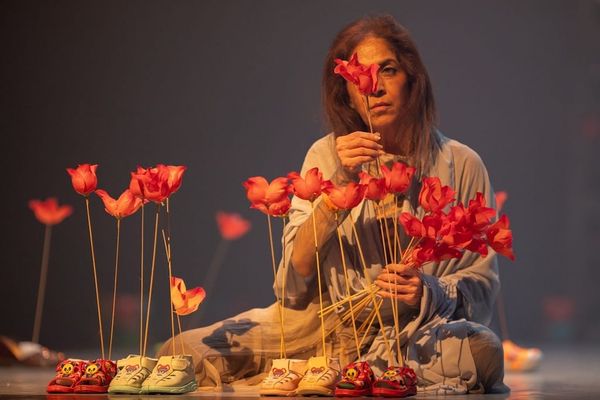
John Tavener's 'Krishna' at Grange Park Opera
World Premiere, 4 June 2026; Performance Reviewed: 13 June. Sir John Tavener's 'Krishna' transforms episodes from Hindu mythology into a visually rich and spiritually ambitious opera, combining haunting music, vivid imagery and moments of transcendence.

It was Prince Charles, now Kings Charles III, who first alerted director Sir David Poutney to the existence of Sir John Tavener’s opera about Krishna. The British composer, who died in 2013 aged 69, was fascinated by the divine. He converted to the Eastern Orthodox Church and his most popular piece is the ethereal Protecting Veil for cello and strings inspired by the Orthodox feast for the Mother of God. While he wrote several pieces closely-linked to the Orthodox Church, he also wrote music on Islamic, Sufi and Hindu themes.
Needless to say John Tavener’s Krishna is no conventional opera, he calls it “a mystical pantomime”. Essentially it’s a series of tableaux depicting scenes from the colourful life of Krishna, many of these - like stealing the clothes of the bathing gopis and the raslila dance - are frequently depicted in Indian painting. Some other familiar episodes like the boy Krishna lifting Mount Govardhan to protect the villagers of Braj and livestock from Indra’s storms are not included, although there are plenty of scenes that are included that can't be portrayed literally, like Krishna’s mother seeing the whole universe in his mouth, or Krishna killing a serpent, which looked like a dreadful production of Wagner. But Krishna inhabits a world that is half human, half divine and that comes across on stage.
The music is at times haunting, particularly the vocals associated with Krishna involving repeated, oscillating phrases which keep recurring throughout. You could hear people singing it in the dinner interval, an unusual experience at a contemporary opera!
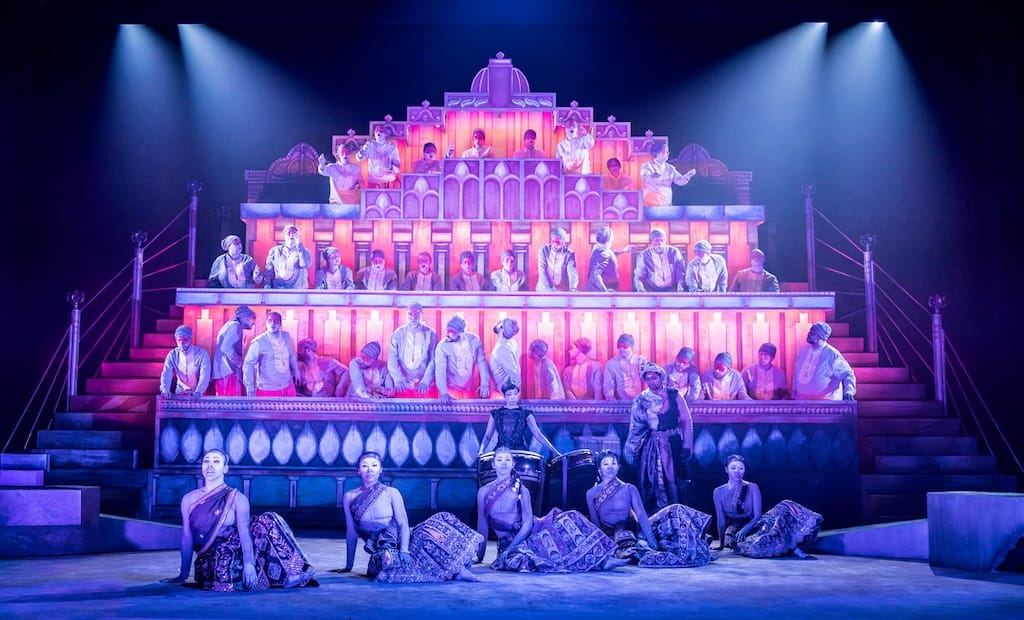
There are actually four Krishnas, as an infant, a child, an adolescent and a warrior and frequently all four are singing at the same time, one woman, three men. Tavener makes no attempt to imitate Indian music. On stage there are three Japanese taiko drums - and there are others in the orchestra pit - although the player on stage, Nao Masuda, isn’t as adept as she should be. There are lots of bells in the score and large almost Messiaen-like blocks of sound. There are eight flutes, for this flute-playing deity, both in the pit and laced through the auditorium. They create a kind of ‘halo’ around Krishna’s voice. The extremely unconventional orchestral score was conducted by Mark Shanahan.
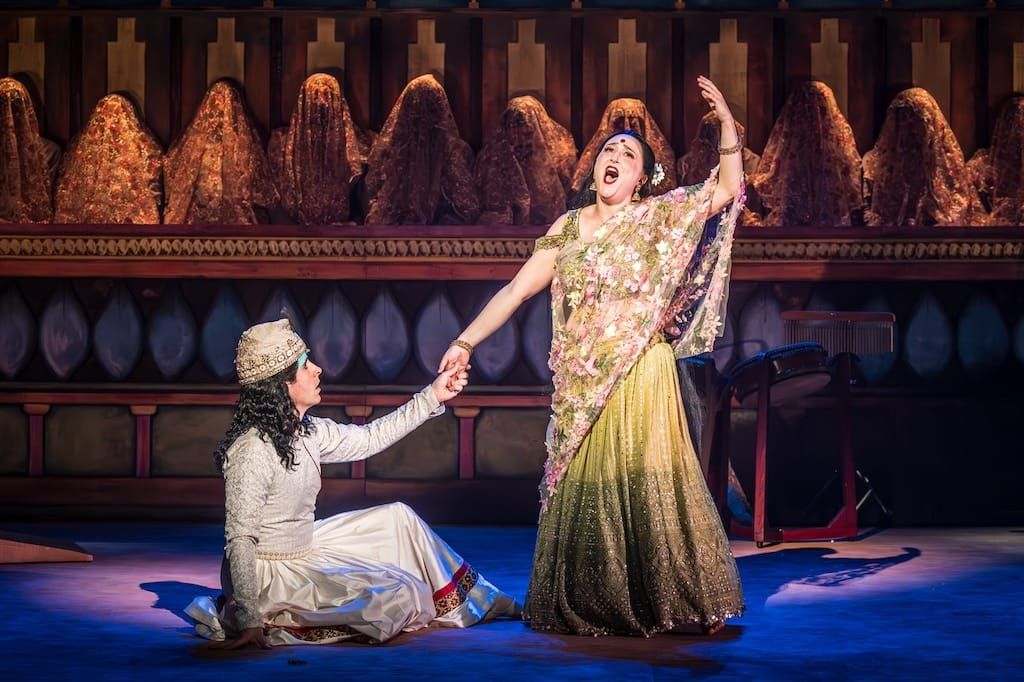
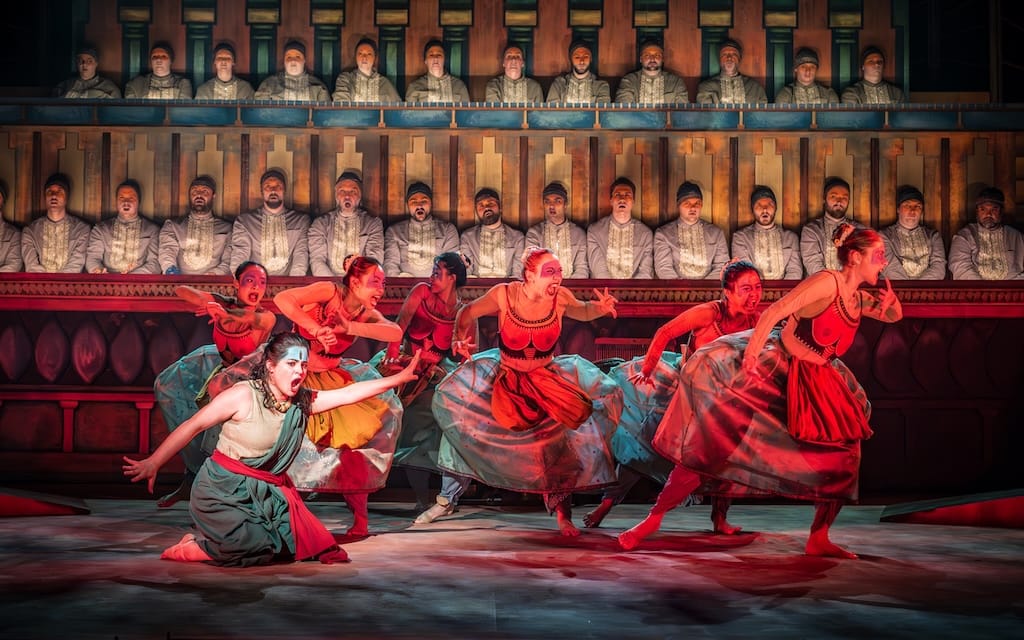
There is, of course, a surfeit of love music from Krishna and Radha and Krishna and Rukmini and it’s particularly the music with Radha where the score becomes most ecstatic. Julia Sitkovetsky brilliantly brings off the virtuosic role of Radha which soars to stratospheric heights - Tavener confessed he was influenced by Mozart’s Queen of the Night. But the stage production also includes a chorus - seated on a temple-like structure designed by Rachana Jadhav and six dancers choreographed by Indian-born, UK resident Shobana Jeyasingh. The colours of the stage set and the costumes do bring a distinctly Indian flavour.
There are two problematical things. The ‘Celestial Narrator’, sung by Ross Ramgobin, who is very useful in outlining the 13 scenes, but whose music is ungrateful on the ear. And the opening scene featuring the weeping cow Bhumi, who doesn’t remotely resemble a cow and makes for an unpromising beginning.
At the end, Krishna bids the Earth farewell and goes to paradise, the ‘temple’ transforming into a funeral pyre. The music reaches some sort of apotheosis and there’s a repeated phrase as Krishna ascends - which I’m told is from the slow movement of Mozart’s Piano Sonata No. 10. Whether this piece had any particular associations for Tavener I don’t know, but it certainly adds an other-worldly quality to the end of the opera, unlike anything that’s gone before.
So is Krishna worth hearing? Absolutely, as one of the final major pieces by John Tavener and one that ties into his lifetime obsession with the spiritual. And a piece that contains some divine music.
Krishna will next be performed at Grand Opera Houston in Autumn 2027.