Understanding Programme Notes: What Are They Really Saying?
Programme notes are not instructions on how to feel, but invitations to listen more deeply. Read with curiosity rather than obedience, they illuminate context, structure and history while leaving space for your own imaginative and emotional response.

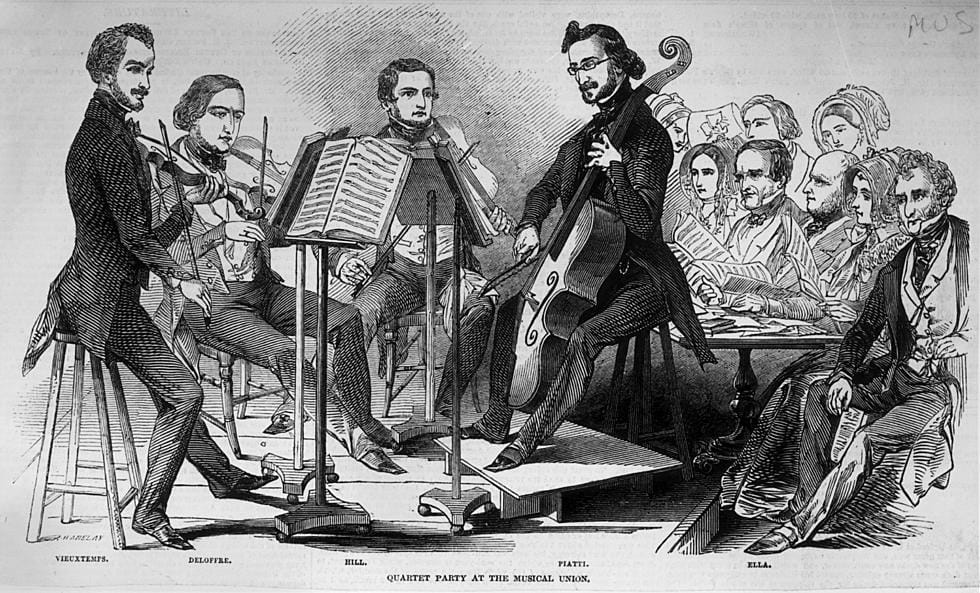
For many concertgoers, programme notes occupy a curious space. They are printed carefully in elegant booklets or displayed on glowing screens, placed somewhere between scholarship and marketing, between invitation and explanation. Some read them avidly before the first note sounds. Others avoid them entirely, preferring to experience the music without mediation. Many skim them, emerging slightly bewildered by references to sonata form, leitmotifs or socio-political upheavals in 19th-century Vienna.
So what are programme notes really saying, and how should we read them?
At their best, programme notes are companions. They do not tell you what to think or what to feel. Rather, they offer a set of keys, historical, structural and imaginative, that can unlock aspects of the music you might not otherwise notice. They illuminate context, trace connections and suggest ways of listening. At their worst, they can feel dense, self-important or oddly detached from the visceral experience unfolding on stage.
Understanding programme notes requires recognising what they are designed to do, and what they are not.
A Brief History of Explaining Music
In the 18th century, audiences attending performances of works by composers such as Joseph Haydn or Wolfgang Amadeus Mozart would not have encountered detailed analytical essays in their hands. Concert life was more informal, and much of the repertoire was new. Listeners often knew the conventions of form and style intuitively because they were immersed in them.
The rise of public concert culture in the 19th century, particularly around figures such as Ludwig van Beethoven, transformed this landscape. Music began to be treated as a serious art requiring attentive listening. The symphony, especially, acquired a quasi-philosophical aura. Audiences returned to the same works repeatedly, and a canon took shape. As the repertoire grew older and more complex, so did the need to contextualise it.
Programme notes emerged as a bridge between composer, performer and listener. They explained unfamiliar forms, translated foreign titles and offered narratives for instrumental works that had no text. In an age increasingly concerned with biography and psychology, they also began to link musical gestures to moments in a composer’s life.
Today’s programme notes are heirs to this tradition. They operate within a culture that values historical awareness and analytical insight. Yet they are also shaped by practical realities: limited space, diverse audiences and the marketing needs of institutions.
The Layers Beneath the Language
When you read a programme note, you are often encountering several layers at once.
First, there is context. You may learn that a symphony was written during political upheaval, personal crisis or artistic transition. A note on a concerto by Pyotr Ilyich Tchaikovsky, for instance, might mention its troubled premiere or the composer’s fragile emotional state at the time. These details are not there to reduce the music to biography, but to frame it within a broader human story.
Secondly, there is structure. Terms such as sonata form, development, recapitulation or scherzo frequently appear. These are not mere technicalities. They describe patterns of expectation and return, tension and release. When a note explains that a movement begins in one key and resolves in another, it is pointing to a journey. Harmony is not simply an academic concept; it is a way of organising emotion over time.
Thirdly, there is listening guidance. Phrases such as ‘notice the hushed strings beneath the oboe melody’ or ‘a restless rhythm drives the music forward’ are invitations. They draw your ear to particular textures or motifs. A well-written programme note does not dictate your response but suggests where you might focus your attention.
Finally, there is interpretation. Every programme note reflects choices about what matters. One writer may emphasise political context, another formal innovation, another the work’s reception history. None of these perspectives is neutral. They shape the narrative through which you approach the music.
The Problem of Jargon
One of the most common complaints about programme notes is that they can be impenetrable. References to diminished sevenths or cyclic transformation may alienate those without formal musical training.
Yet jargon is not always the enemy. Some terms have precise meanings that are difficult to replace without losing nuance. The word ‘modulation’, for example, concisely describes a shift from one key to another. Avoiding it entirely may lead to clumsy paraphrase.
The issue is less the presence of technical language and more the absence of explanation. A considerate programme note assumes intelligence, not prior expertise. It introduces necessary terms and places them within an accessible framework. It respects both the seasoned listener and the curious newcomer.
There is also a deeper question. Must one understand form to appreciate music? The short answer is no. Music communicates directly through sound. However, awareness of structure can enrich the experience. Recognising that a theme returns transformed at the end of a movement can heighten the sense of resolution. Knowing that a composer is subverting expectations can sharpen the thrill of surprise.
Programme notes are therefore tools. They are not prerequisites for enjoyment but resources for those who wish to listen more attentively.
Narrative Versus Abstraction
Some works come with explicit stories. A symphonic poem inspired by literature or a ballet score grounded in myth may invite narrative description. Others, particularly so-called absolute music, resist such framing.
Writers of programme notes often walk a delicate line. They may be tempted to invent imagery for abstract works in order to make them more relatable. Yet imposing a story where none was intended can narrow the listener’s imaginative space.
Consider the music of Johannes Brahms. His symphonies are rarely tied to explicit programmes. To describe the opening of a movement as ‘stormy’ or ‘tragic’ is already to guide the emotional response. Such adjectives may resonate with many listeners, but they are interpretative choices, not facts.
The most balanced programme notes acknowledge this subjectivity. They offer metaphors lightly, as possibilities rather than prescriptions. They might suggest that a theme has a ‘yearning quality’ while recognising that another listener may hear defiance or serenity.
Contemporary Music and the Need for Mediation
If older repertoire sometimes feels distant because of historical context, contemporary music can feel challenging because of unfamiliar language. Dissonance, unconventional forms or extended instrumental techniques may unsettle expectations.
In these cases, programme notes play a particularly vital role. They can articulate a composer’s intentions, explain unusual sounds and situate the work within current artistic conversations. For a premiere by a living composer, the note may include the composer’s own words, offering insight into the creative process.
However, there is a risk of over-explaining. When a note becomes a manifesto, dense with theoretical references, it can erect a barrier rather than build a bridge. The listener may feel that understanding the music requires mastering an entire philosophical framework.
Clarity and concision are crucial. A few well-chosen sentences can illuminate more effectively than a page of abstract argument.
Marketing and Myth-Making
Programme notes do not exist in a vacuum. Orchestras, festivals and venues operate within competitive cultural markets. Describing a work as ‘revolutionary’, ‘ground-breaking’ or ‘iconic’ is not purely analytical; it is promotional.
This does not invalidate the content, but it is worth recognising the tone. Language can subtly elevate certain composers while marginalising others. The canon itself has been shaped by centuries of critical writing and institutional reinforcement.
A reflective reader approaches programme notes with gentle scepticism. What is being emphasised? What is omitted? Whose voices are quoted, and whose are absent? Increasingly, institutions are revisiting repertoire with an eye towards diversity and inclusion. Programme notes can either perpetuate inherited hierarchies or challenge them by broadening context and acknowledging overlooked perspectives.
How to Read Programme Notes
There is no single correct way to engage with programme notes. Some prefer to read them before the performance, constructing a mental map in advance. Others read them afterwards, reflecting on what they heard. Both approaches have merit.
Reading beforehand can enhance anticipation. You might listen for a particular motif or structural turning point. Reading afterwards allows you to compare your own impressions with those of the writer. Did you hear the same contrasts? Did you experience the climax where the note suggested it would occur?
It can also be liberating to ignore certain sections. If detailed harmonic analysis feels overwhelming, focus on the broader narrative. If biography does not interest you, turn to the description of musical character. Programme notes are modular; you need not consume them in their entirety to benefit.
Above all, treat them as conversation rather than authority. They are one voice among many, including the composer’s, the performers’ and your own.
The Listener’s Responsibility
In the end, understanding programme notes is less about decoding technical language and more about cultivating attentive listening. The page cannot substitute for the experience of sound unfolding in real time.
Music remains an art of presence. A melody shaped by breath, a chord resonating in a hall, a silence charged with expectation, these are phenomena that resist full capture in words. Programme notes attempt to translate aspects of that experience into language, but they are always secondary.
Perhaps the most generous way to approach them is with curiosity. Ask not only what they are saying, but why. Why has the writer chosen this historical anecdote? Why highlight this structural feature? What perspective does it offer, and how does it align or conflict with your own response? When read with openness and discernment, programme notes enrich rather than constrain.