How to Listen to a Symphony: A Guide for Curious First-Time Audiences
Listening to a symphony does not require expertise, only curiosity. This guide offers first-time audiences practical ways to engage with orchestral music, from following musical conversations to embracing emotion, attention, and discovery in the concert hall.


Walking into a concert hall for a symphony performance can feel both exciting and intimidating. The setting is formal, the musicians are many, and the music itself often unfolds over long stretches without words to guide the listener. For those encountering orchestral music for the first time, the question is not whether one will enjoy it, but how one is meant to listen.
The good news is that there is no single correct way to experience a symphony. Unlike technical disciplines that require prior knowledge, orchestral music rewards curiosity, patience, and openness. This guide is intended not to instruct you on what to think, but to offer tools that can help you listen with greater confidence and pleasure.
Let Go of the Fear of Not Understanding
One of the most common anxieties among first-time listeners is the fear of not understanding the music. Classical music is often presented as something that requires education or specialised knowledge, but this perception can be misleading.
A symphony does not need to be decoded like a puzzle. It communicates through sound, texture, rhythm, and emotional contrast. You do not need to identify the key, recognise the composer’s influences, or follow a programme note word for word. Listening to a symphony is closer to watching a landscape unfold than solving a problem.
If you feel moved, restless, surprised, or contemplative, you are already listening successfully.
Understand What a Symphony Is, in Simple Terms
A symphony is a large-scale work for orchestra, typically lasting between 30 and 60 minutes. Most symphonies are divided into movements, usually three or four, each with its own character and tempo.
While the structure varies, a traditional symphony often includes:
- A substantial opening movement that introduces key musical ideas
- A slower movement that explores mood and lyricism
- A dance-like movement or scherzo that adds energy or humour
- A final movement that brings resolution or dramatic contrast
You do not need to remember these labels during the performance, but knowing that the music is organised into distinct sections can help you stay oriented as you listen.
Watch as Much as You Listen
In a live concert, your eyes can be as helpful as your ears. Observing the orchestra provides visual cues that make the music more approachable.
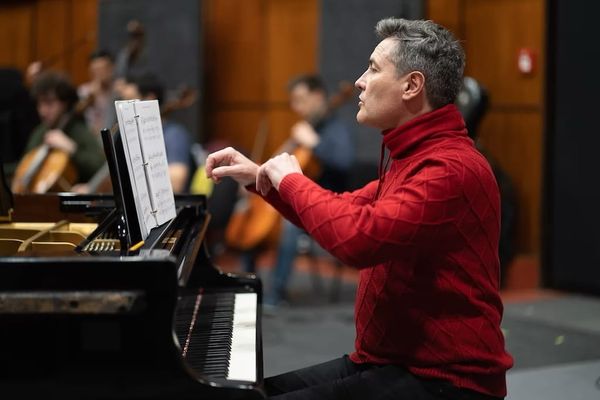
Notice the conductor’s gestures. Large, sweeping movements often signal powerful passages, while smaller, contained motions may accompany quieter, more intimate moments. Watch how different sections of the orchestra come to life at different times. The violins may carry a melody, only for it to be taken up later by the woodwinds or brass.
Seeing how sound is physically produced helps demystify the experience. The music becomes a collective human effort rather than an abstract wall of sound.
Follow the Musical Conversation
A symphony is not a monologue but a conversation among instruments. Themes are introduced, repeated, transformed, interrupted, and sometimes contradicted.
Try listening for patterns. A melody you hear early on may return later in a different mood or colour. A rhythmic figure might reappear in another section of the orchestra. You do not need to track every recurrence, but recognising even one familiar idea can create a sense of connection and anticipation.
Think of the orchestra as a group of voices speaking in turn, sometimes agreeing, sometimes arguing, sometimes whispering together.
Accept That Attention Will Drift, and That Is Fine
Many people worry when their attention wanders during a long symphony. This is entirely natural. Even seasoned listeners experience moments of distraction.
Rather than resisting this, allow yourself to re-enter the music when something catches your ear. A sudden change in volume, a solo instrument, or a shift in mood can gently pull you back. Listening does not require constant concentration to be meaningful.
Music has a way of working on the listener even when one is not fully focused. Trust that you are absorbing more than you realise.
Use Emotion as Your Guide
You may not always know what is happening structurally, but you can always notice how the music makes you feel. Does a passage feel tense or expansive? Restless or serene? Playful or solemn?
There is no obligation to attach a specific story or image to the music, but allowing emotional responses to arise can be deeply rewarding. Different listeners often experience the same symphony in different ways, and this diversity of response is part of its richness.
If a section leaves you unmoved or confused, that is also acceptable. Listening is a personal experience, not a test.
Do Not Worry About Concert Etiquette Too Much
Concert etiquette can be a source of anxiety for newcomers, but it is simpler than it appears. The main expectation is quiet attentiveness during the performance.
Applause usually occurs at the end of the entire symphony rather than between movements, although this convention is evolving and occasional applause between movements is increasingly accepted. If you are unsure, you can simply wait and follow the lead of the audience around you.
Most importantly, remember that concert halls exist for listening, not for judging. Your presence as an engaged listener is what matters.
Programme Notes Are Optional, Not Essential
Programme notes can offer useful context about the composer, historical background, or musical structure, but they are not required reading. Some listeners enjoy reading them in advance, while others prefer to encounter the music without preconceptions.
If you choose to read them, treat them as a guide rather than a set of instructions. The music does not need to align with the notes to be effective. Often, the most memorable moments are those that surprise you beyond what you have read.
Listening Improves with Familiarity, Not Expertise
The more you attend concerts, the more comfortable the experience becomes. Over time, you may start recognising orchestral colours, forms, or composers’ styles, but this happens naturally through repeated exposure.
There is no need to rush this process. Even hearing the same symphony more than once can be illuminating, as different details emerge with each encounter. What initially felt long or complex may later feel cohesive and expressive.
Listening is a skill that grows through enjoyment rather than effort.
After the Concert, Reflect Casually
You do not need to analyse the performance in detail, but taking a moment to reflect can deepen your connection to the experience. Ask yourself simple questions. Was there a moment that stood out? Did any instrument catch your attention? Did your mood change during the concert?
Discussing these impressions with a companion can also be enriching. There are no correct answers, only shared perspectives.
A Symphony Is an Invitation, Not a Challenge
At its core, a symphony invites the listener into a shared space of sound, time, and imagination. It does not demand expertise or background knowledge, only a willingness to listen.
For first-time audiences, the most important thing is to arrive with curiosity rather than expectation. Let the music unfold at its own pace. Allow yourself to be surprised, unsettled, or moved in ways you did not anticipate. The act of listening, attentive and open, is already enough.