Granados on Two Guitars: Eugenio Della Chiara & Pietro Locatto on Transcription, Tradition and Duo Intimacy
Piano-born yet guitar-haunted, Granados’s 'Danzas españolas' find new life in a complete duo transcription by Eugenio Della Chiara and Pietro Locatto. They discuss tradition, tuning, colour, and the intimacy of playing as one.
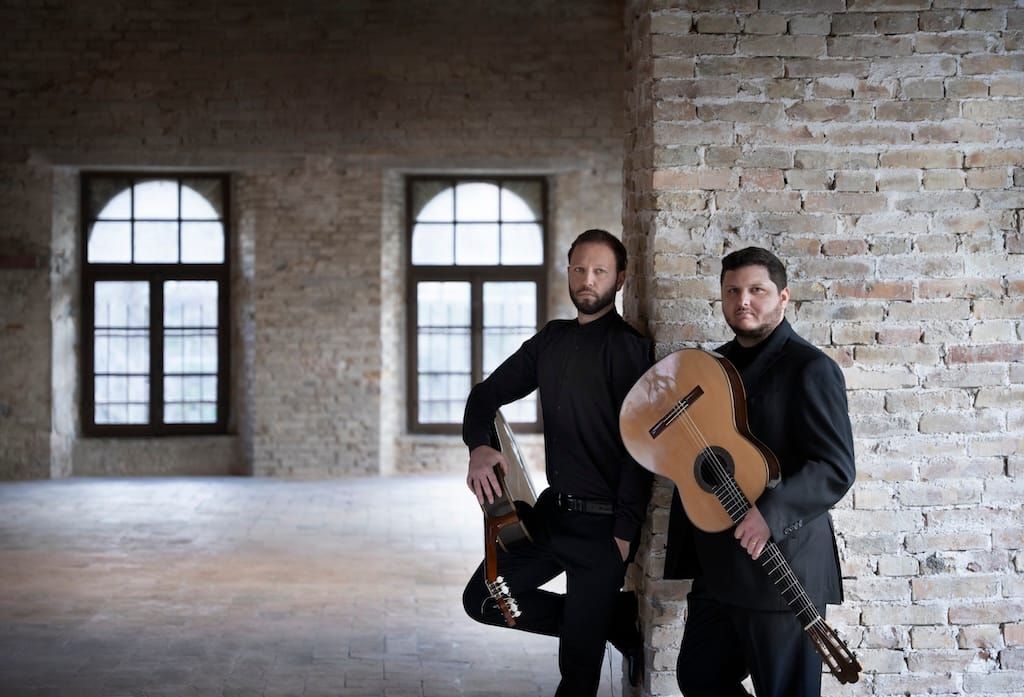
Enrique Granados’s Danzas españolas have always carried the guitar in their shadow: a sense of dance, colour and song that seems to rise naturally from the instrument’s own language, even when the music is played at the piano. For their new recording, guitarists Eugenio Della Chiara and Pietro Locatto complete the entire cycle in newly crafted transcriptions for two guitars, alongside historic arrangements by Miguel Llobet, restoring these musical “paintings” to a sound world they seem to have been waiting for all along. In this joint interview, the duo speak about tradition and reinvention, the technical imagination behind playing in Granados’s original keys, and the intimate art of building a shared voice from two distinct musical lives.
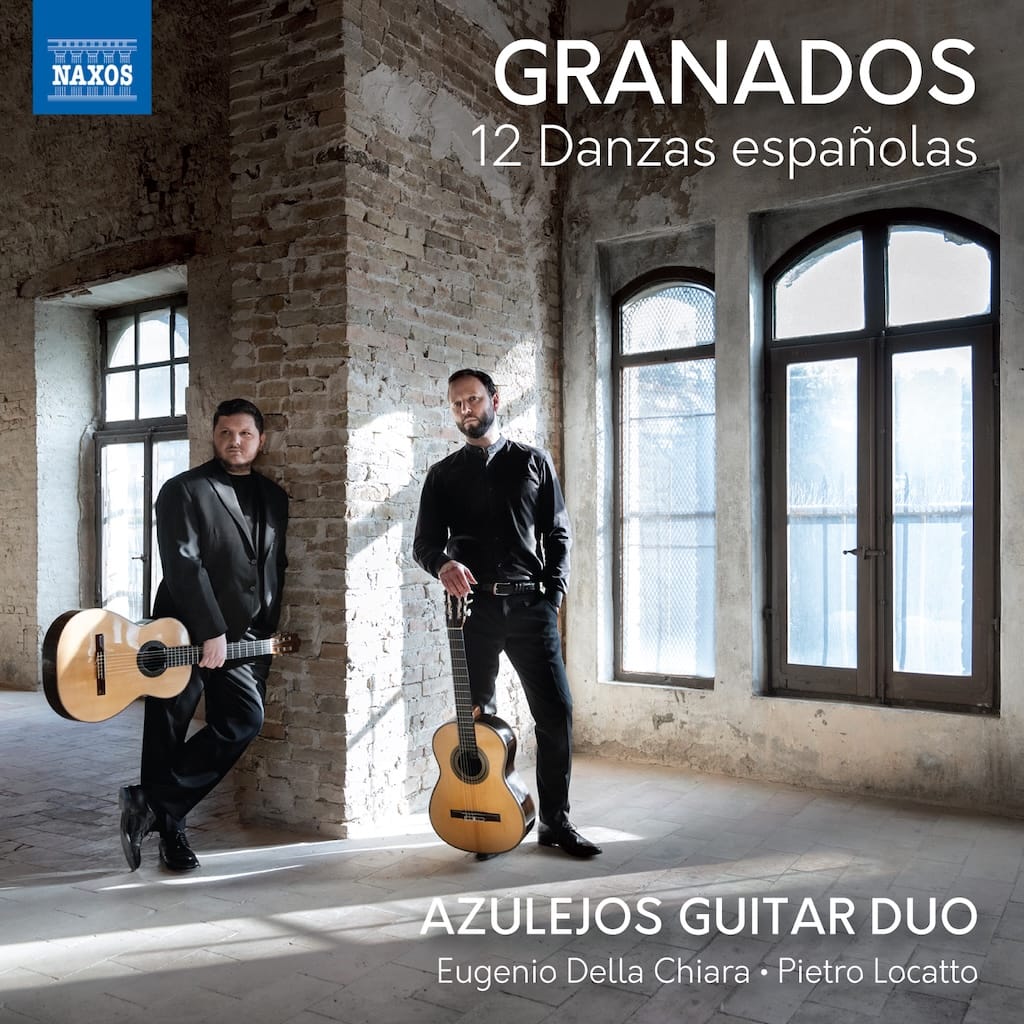
Nikhil Sardana: Granados’ Danzas españolas and Capricho español were originally written for piano, yet they have long lived in the imagination as “guitar music”. What drew the two of you specifically to create this new complete transcription for guitar duo?
Pietro Locatto: This repertoire and expressive world have been with me since my very first steps in music and the guitar, and they’ve continued to accompany my concerts and many of my recordings. In Eugenio, I found a long-lost brother in this shared passion. For me, it felt completely natural to accept his proposal to transcribe the entire cycle. Performing this music as a duo offers far greater possibilities than a single guitar, and I was fascinated by the idea of tackling the complete set of dances in their original keys.
Eugenio Della Chiara: What motivated us to create these transcriptions was perhaps the same impulse felt by Llobet and the first guitarists who approached Granados’s music: the sense that, in many of the Catalan composer’s works, the presence of the guitar is implicit — almost latent — emerging like a watermark beneath the notes. In a way, our work consisted simply in making tangible the suggestions and references to our instrument that were already inherent in the music itself.
NS: The recording includes both your own new arrangements and the historic Llobet transcriptions. How did you approach balancing respect for tradition with your own interpretative voice in the pieces you newly transcribed?
PL: We hold great respect for Llobet’s legacy. In fact, we began precisely with those transcriptions, and then built all the others around them in order to complete the cycle. I believe it was important for both Eugenio and me to have lived with so much of that repertoire — to have that guitar background behind us. Transcribing is like translating into another language: it means constantly making decisions, choosing how to convey meaning through sound. Having been immersed in that style for so long meant we “spoke the same language”, so to speak. As a result, the choices we made felt natural, and we consistently found ourselves in agreement.
EDC: The first requirement for placing oneself within a tradition is to know it and love it, and I can say with certainty that we both have a deep affection for Llobet’s expressive universe. As with any engagement with an artistic phenomenon of the past, one must discern what can still speak meaningfully today and what is inseparably bound to the taste of a bygone era. For me, this was essential in identifying which of Llobet’s principles of transcription could genuinely become my own.
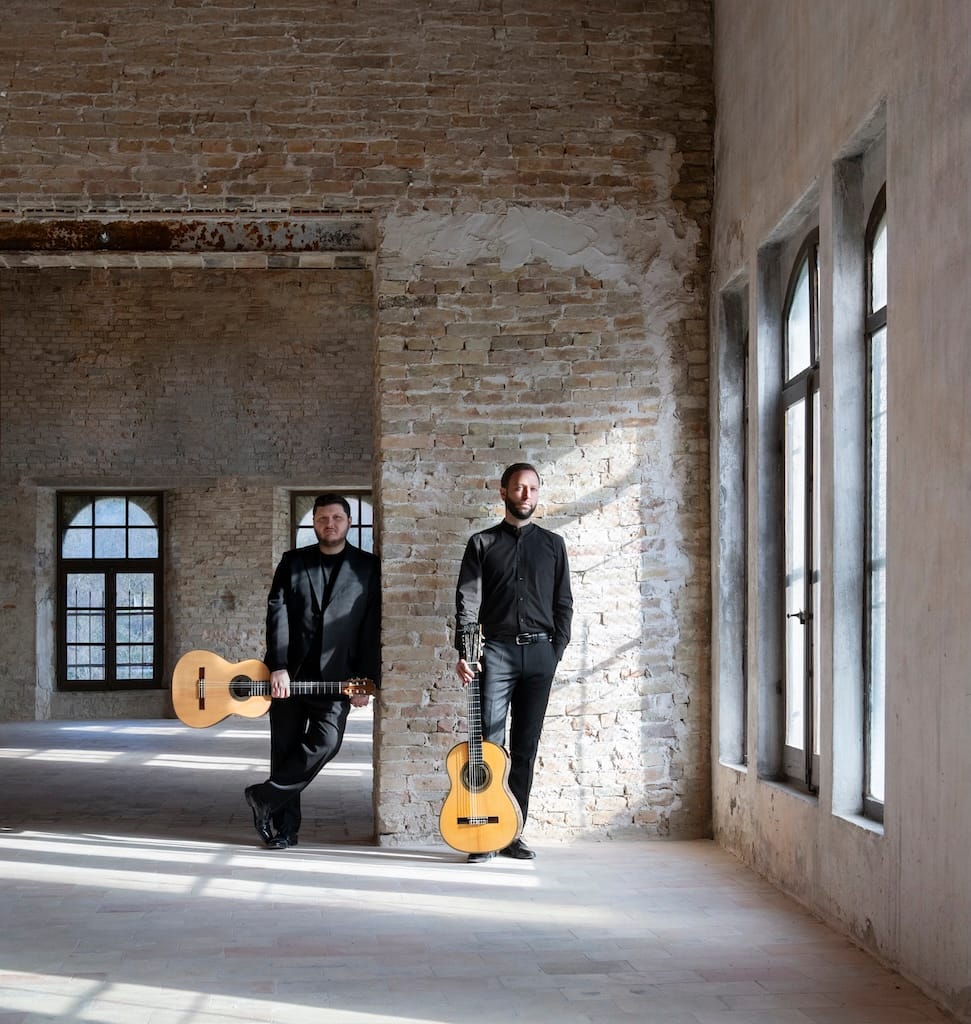
NS: Your artistic paths are shaped by different influences: from literary and scholarly study to deep work in Spanish repertoire and luthiery. How do each of your backgrounds shape the sound you create together?
EDC: For my conception of the duo, coming from different human, musical and educational experiences is invaluable. Our sound is the result of dialogue rather than a search for total homogeneity. The only aspect on which it is essential to be united is our conception of the guitar itself: for both Pietro and me, it is an instrument whose uniqueness lies in its almost infinite chromatic potential and its deeply melancholic cantabile quality.
PL: Each of our backgrounds has shaped who we are at this moment. Our studies, the environments in which we trained and grew, everything we have received — and continue to receive — has helped to form our sensitivity and, therefore, our interpretative capacity. What you encounter now is the synthesis of our paths, captured in this moment: all of it has been valuable, and it can certainly be traced in the way we play. But just like a colour created by blending different pigments, in the end you must look at it as a whole to understand it, rather than breaking it apart to isolate its components — and so it is with us, and with any performer.
NS: You chose to keep the original keys throughout the set, even when this required inventive tuning and extended technique on the guitar. Could you share one example where this decision reshaped your relationship with the instrument?
PL: For guitarists, this kind of strategy is quite common — not only in transcriptions, but also in much of the original repertoire. Our instrument requires this sort of flexibility in tuning and technique in order to render different keys effectively. These are not especially rare devices, but as an example: my guitar moves from standard tuning in E to tuning in G (fifth string to G and sixth to D), or in B flat (fifth to B flat and sixth to D), or in D (sixth to D)… and then, of course, there is always the capo for the more intricate situations.
EDC: There are two dances — the second and the eighth — in which one of the two guitars uses a tuning with the fifth string lowered to G and the sixth to C. This tuning has very few precedents; one notable example is its use by Agustín Barrios Mangoré in his beautiful transcription of Schumann’s Träumerei from Kinderszenen. Personally, having access to such a deep bass C gave the instrument a particular depth, which in turn altered my approach even to the higher registers.
NS: You have been performing together for many years, but this project seems particularly rooted in shared aesthetic sensibilities. How would you describe your musical partnership, and did it evolve during the making of this album?
PL: In fact, it is quite the opposite: we met precisely on this terrain, and the years together are still ahead of us. I think we connected so well because, beyond being good friends, we were driven by shared desires — expressed through different techniques, but guided by similar underlying sensibilities, born from similar backgrounds. This is only the beginning; the journey, and our musical understanding, can only grow.
EDC: I believe the key word to describe our musical collaboration is complementarity. We don’t listen to the same music, we don’t always share the same aesthetic horizons, and we’re not necessarily drawn to the same references. In short, we are not alike — and I think this is precisely our strength. Personally, discovering and understanding Pietro’s point of view opens up perspectives I probably wouldn’t have considered on my own, generating a richness of thought that is extremely valuable in our work.
NS: Spanish impressionist repertoire has been central to both of your artistic identities. What continues to draw you to this world, and how does Granados speak differently through the medium of two guitars?
EDC: I’m drawn to Spanish Impressionism because I see it as deeply connected, both aesthetically and expressively, to what I consider the guitar’s natural characteristics. This connection remains intact across generations, from Albéniz and Granados to de Falla and Turina. Through the medium of two guitars, Granados’s voice — more intimate than when entrusted to the piano — gains a richness of colour that perhaps allows us to discover its most hidden soul.
PL: Impressionism is the truest soul of our instrument’s rebirth — how could one not appreciate it? The modern guitar was born thanks to Torres, and this rebirth immediately led to this repertoire, this technique, this sensitivity, and these composers. To ignore it would mean not knowing one’s origins. And then there is the aspect of two guitars: an immensely enjoyable way of making music. The guitar does not lose its evocative nature, but it gains a much broader range of possibilities — and almost effortlessly so.
NS: Both of you are also educators, curators, and collaborators with ensembles and singers. How do these broader musical experiences shape the way you approach repertoire, colour, and phrasing in a guitar duo?
PL: As I said earlier, I don’t know exactly how — but every experience remains and helps in the ones that follow. Playing with others always challenges one’s ability to listen, to empathise, and to be flexible. In a guitar duo, even more so than in other ensembles where the guitar almost always has a very different function compared to the other instrument. Here, instead, the tasks are divided differently, and creating a unified whole is more delicate — not automatic, but necessary. A guitar duo is more similar to the two hands of a single pianist than to a “duo” in the traditional sense.
EDC: I’m deeply convinced that music is communication and, ultimately, thought. Any experience that broadens the field in which this communication takes place is therefore essential — from teaching to historical performance practice, which in my case has been particularly important in recent years. Moreover, the fact that we both work extensively in duo settings with voices and string instruments greatly enhances our ability to support the melodic line — which, in different ways, defines both of us.
NS: Guitar duos can be extremely intimate ensembles. What have you learned from each other, either musically or personally, through this long partnership?
PL: I have certainly learned to listen to and understand Eugenio better. In a small formation like a duo, what really matters is precisely learning to understand the other person — how they work, how they react, how to make them react… and how to blend my sonic colour with theirs. Perhaps that is the most interesting challenge in a guitar duo. But in the end, everything comes down to listening, to human empathy, and consequently to musical empathy.
EDC: I can certainly say that I’ve learned — and I mean this in the most positive sense — that you never truly know the other person. This may sound unsettling, but I genuinely believe that the most precious aspect of any relationship is never taking the person in front of you for granted. Any relationship is bound to collapse when the other becomes merely a mirror. How valuable it is, instead, to rely on an otherness — on someone who will always tell you what you truly need to hear, rather than what you might want to hear.