Bridging Indian and Jazz Rhythms: An Exploration of Fusion
This article explores the meeting point of Indian rhythmic systems and jazz syncopation, examining how tala and swing interact in fusion music, and how artists create new rhythmic languages rooted in tradition yet open to experimentation.

Few musical encounters are as intellectually stimulating and viscerally exciting as the meeting of Indian classical rhythm and jazz. Both traditions are deeply rhythmic at their core, yet they approach time, structure, and improvisation in markedly different ways. When brought together, they create a fertile ground for innovation.
Indian music, whether Hindustani or Carnatic, is built upon intricate rhythmic cycles known as tala. Jazz, on the other hand, thrives on swing, syncopation, and a flexible sense of pulse. Fusion between the two does not simply involve layering one over the other. It requires a deeper understanding of how these rhythmic systems function and how they can meaningfully interact.
Understanding Tala
At the heart of Indian rhythm lies the concept of tala, a cyclical framework that organises beats into repeating patterns. Each tala has a specific number of beats and a defined internal structure, often divided into sections marked by claps, waves, or accents.
For instance, Teentaal, one of the most widely used cycles in Hindustani music, consists of sixteen beats grouped into four equal sections. Carnatic music, meanwhile, offers even greater complexity, with cycles that can be subdivided in multiple ways and expanded through mathematical permutations.
Within this framework, improvisation is both disciplined and inventive. Musicians develop phrases that align with the cycle while also playing with expectation and resolution. The return to the first beat, known as sam, is particularly significant, serving as a point of convergence and emphasis.
Jazz Rhythm
Jazz approaches rhythm with a different philosophy. Rather than fixed cycles, it often relies on a steady underlying pulse, typically organised into measures of four beats. What gives jazz its distinctive character is not the structure itself, but how it is articulated.
Syncopation plays a central role, with accents placed on offbeats or unexpected parts of the measure. Swing, a subtle unevenness in the division of beats, adds a sense of forward motion and elasticity. Together, these elements create a rhythmic language that feels both grounded and fluid.
Improvisation in jazz is closely tied to this rhythmic flexibility. Musicians stretch, compress, and displace phrases, interacting dynamically with one another in real time. The result is a constantly evolving rhythmic landscape.
Points of Convergence
Despite their differences, Indian and jazz traditions share several important commonalities. Both place a strong emphasis on improvisation, requiring musicians to respond intuitively while maintaining structural awareness. Both also value rhythmic sophistication, albeit expressed through different systems.
One of the most compelling points of convergence lies in the concept of tension and release. In Indian music, this is often achieved through rhythmic patterns that resolve at the sam. In jazz, it emerges through syncopation and phrasing that play against the underlying pulse.
Fusion artists have long explored these parallels, finding ways to align cyclical and linear conceptions of time. For example, a jazz ensemble might adapt its phrasing to fit within a tala cycle, while an Indian percussionist might incorporate swing-like accents into their playing.
The Role of Percussion
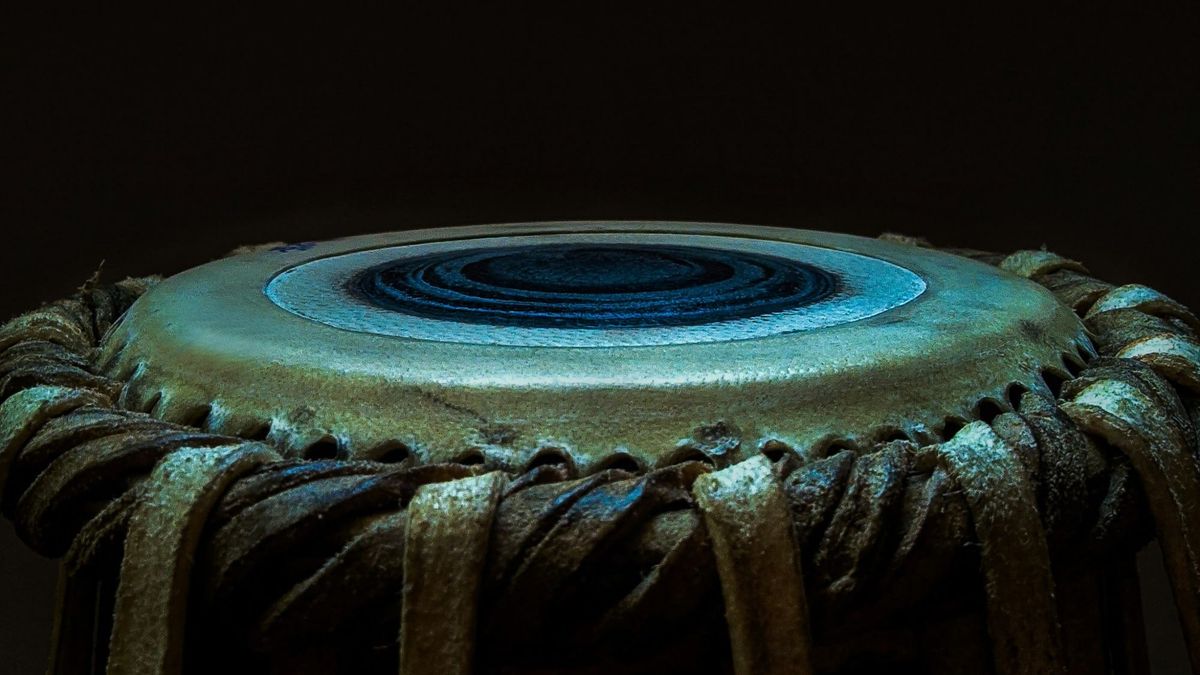
Percussion instruments often serve as the bridge between these traditions. The tabla, with its ability to articulate complex rhythmic patterns and tonal variations, has become a central voice in many fusion contexts. Similarly, the mridangam brings a rich vocabulary of rhythmic syllables and structures.
In jazz settings, the drum kit provides a different but complementary approach. Its capacity for dynamic variation and textural layering allows it to interact fluidly with Indian rhythmic concepts. When these instruments come together, the dialogue can be both intricate and spontaneous.
Percussionists in fusion ensembles often take on expanded roles, not only keeping time but also shaping the overall rhythmic direction. Their ability to navigate between systems is crucial to the success of the collaboration.
Pioneers of Indo-Jazz Fusion
The exploration of Indian and jazz fusion is not new. Artists such as John McLaughlin, through his work with the band Shakti, brought together virtuosic improvisation with deep engagement in Indian rhythmic traditions.
Similarly, tabla maestro Zakir Hussain has collaborated extensively with jazz musicians, demonstrating how Indian rhythm can both complement and challenge jazz frameworks. These collaborations are not mere stylistic experiments, but sustained dialogues that have expanded the possibilities of both traditions.
Their work has influenced a new generation of musicians who continue to explore these intersections, often bringing their own cultural and musical perspectives into the mix.
Challenges in Fusion
While the potential for innovation is immense, fusion also presents significant challenges. Superficial combinations can result in music that feels disjointed or lacks authenticity. True integration requires a deep understanding of both traditions.
One of the primary challenges lies in reconciling different approaches to time. The cyclical nature of tala can be difficult to align with the linear phrasing of jazz. Similarly, the nuances of swing are not easily translated into Indian rhythmic contexts.
Communication is therefore essential. Musicians must develop a shared vocabulary, often through rehearsal and experimentation. This process can be demanding, but it is also where the most meaningful discoveries occur.
Contemporary Directions
Today, the landscape of Indo-jazz fusion is more diverse than ever. Artists are not only blending rhythms but also incorporating elements from electronic music, global traditions, and contemporary classical practices.
Technology has also played a role, enabling new forms of collaboration and experimentation. Digital tools allow musicians to visualise rhythmic patterns, manipulate time, and explore complex structures in ways that were previously difficult.
At the same time, there is a growing emphasis on authenticity and respect. Many contemporary artists engage deeply with the traditions they draw from, often studying them formally before attempting to fuse them.
Conclusion
The fusion of Indian and jazz rhythms is not a fixed genre, but an ongoing conversation. It is shaped by the musicians who engage with it, each bringing their own insights and experiences.
At its best, this fusion does more than combine elements from two traditions. It creates something new, a rhythmic language that is both rooted and exploratory. It challenges performers and listeners alike to rethink their understanding of time, structure, and expression.